
Kevin Zhang is a passionate table tennis coach and the founder of RecRoomPick.com, a site dedicated to helping players and enthusiasts discover the best in indoor games. With years of competitive ping pong experience, Kevin shares expert tips, equipment reviews, and guides on table tennis, foosball, pool, pickleball, darts, and more. His mission is to make indoor recreation fun, accessible, and competitive for everyone.

 Last updated: November 15, 2026
. Figures were checked against the published shuffling research, Harvey Mudd College, Science News and Stanford Magazine, and shuffler details against the manufacturer and Amazon listings, on this date. Recroompick earns a commission on qualifying purchases through the links on this page, at no extra cost to you.
Quick answer: A single pass through a card shuffler is usually not fully random. Mathematicians Dave Bayer and Persi Diaconis showed in 1992 that a 52-card deck needs about seven riffle shuffles before every order is nearly equally likely. When Diaconis’s team tested a casino shuffling machine, it mixed the deck about as well as three riffle shuffles (Science News, 2002), and they advised running the cards through twice. We found no published randomness test of home two-slot shufflers, and none of the shuffler listings we checked publishes one. In our editorial view, run the deck through a home shuffler at least twice for casual games, and add a cut or a hand riffle when it matters.
People ask whether shufflers are random for two reasons: they want fair games at home, and they suspect the machine leaves clumps of cards together. Both concerns have answers in published research, although most of it is about casino machines and hand shuffling rather than the battery shufflers sold for home use.
This guide explains what “random” means for a deck of cards, what the research found, how home shufflers work, and how to get a well-mixed deck with one. It is based on the Bayer and Diaconis research as summarized by Harvey Mudd College and Wikipedia, reporting by Science News and Stanford Magazine, and the shufflers we compared for our best card shuffler guide.
| Method | How it mixes | What the sources say |
|---|---|---|
| Riffle shuffle by hand | Splits the deck and interleaves two halves | About 7 riffles randomize a 52-card deck |
| Overhand shuffle by hand | Moves small packets from hand to hand | About 2,500 shuffles to randomize a 52-card deck |
| Casino shuffling machine (studied) | Drops cards into a set of slots chosen by a random number generator | One pass mixed about as well as 3 riffles; run twice advised |
| Home two-slot shuffler | Feeds cards from two stacks into one tray | No published randomness test found |
Sources: Harvey Mudd College, Wikipedia, Science News, Stanford Magazine and the Amazon listings for the shufflers (full list in the Sources section).
Not after one pass, based on the research we found. Randomness here means every order of the deck is about equally likely, so no one can predict where a card will end up. The math is strict: Bayer and Diaconis showed that even good hand riffles need about seven repetitions for a 52-card deck, and Wikipedia’s summary notes the deck “did not start to become random until five good riffle shuffles”.
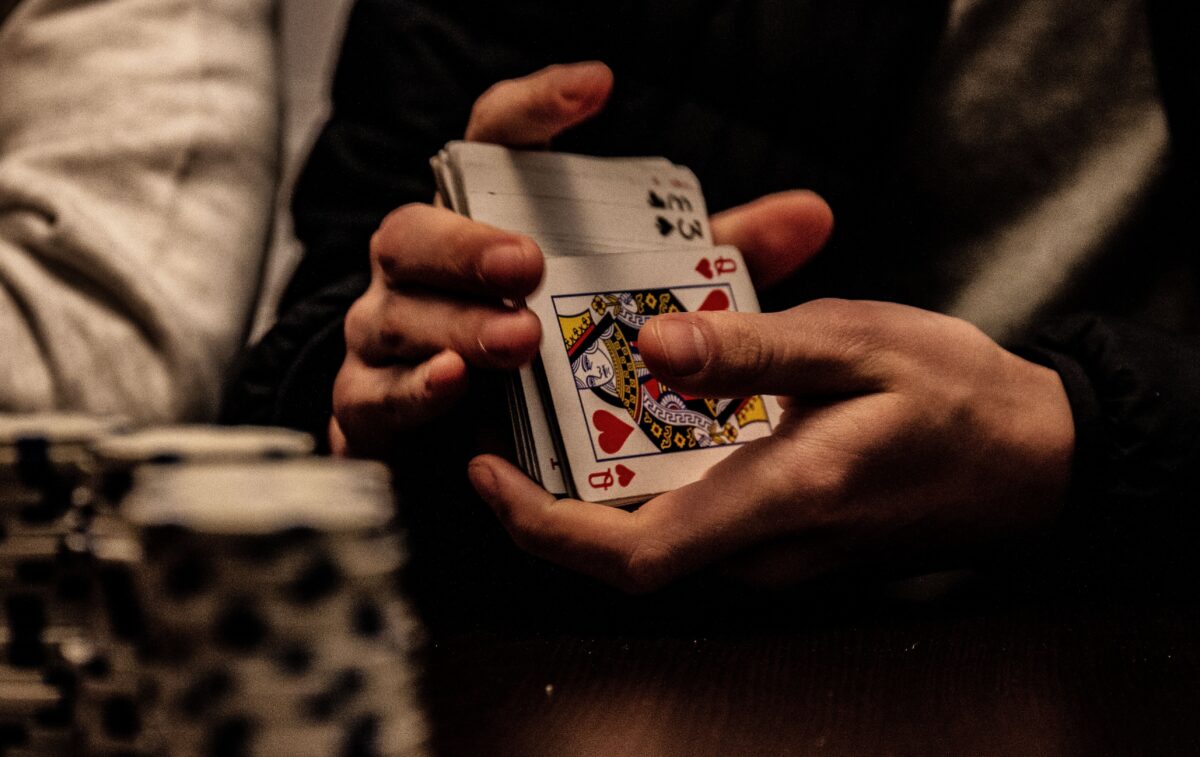
A 52-card deck needs about seven good riffle shuffles before every order is nearly equally likely. Photo by Marin Tulard on Pexels.
Machines face the same math. A machine can be consistent, but consistent is not the same as random: if it mixes the deck only partly, cards that started near each other can stay near each other.
The studies we found are of casino equipment, not home shufflers. Science News reported in 2002 that an automated shuffler, which uses a random number generator to send each card to one of a set of slots, “randomized the deck about as well as three riffle shuffles, well short of the seven riffle shuffles needed”. Diaconis suggested feeding the cards through the machine twice.
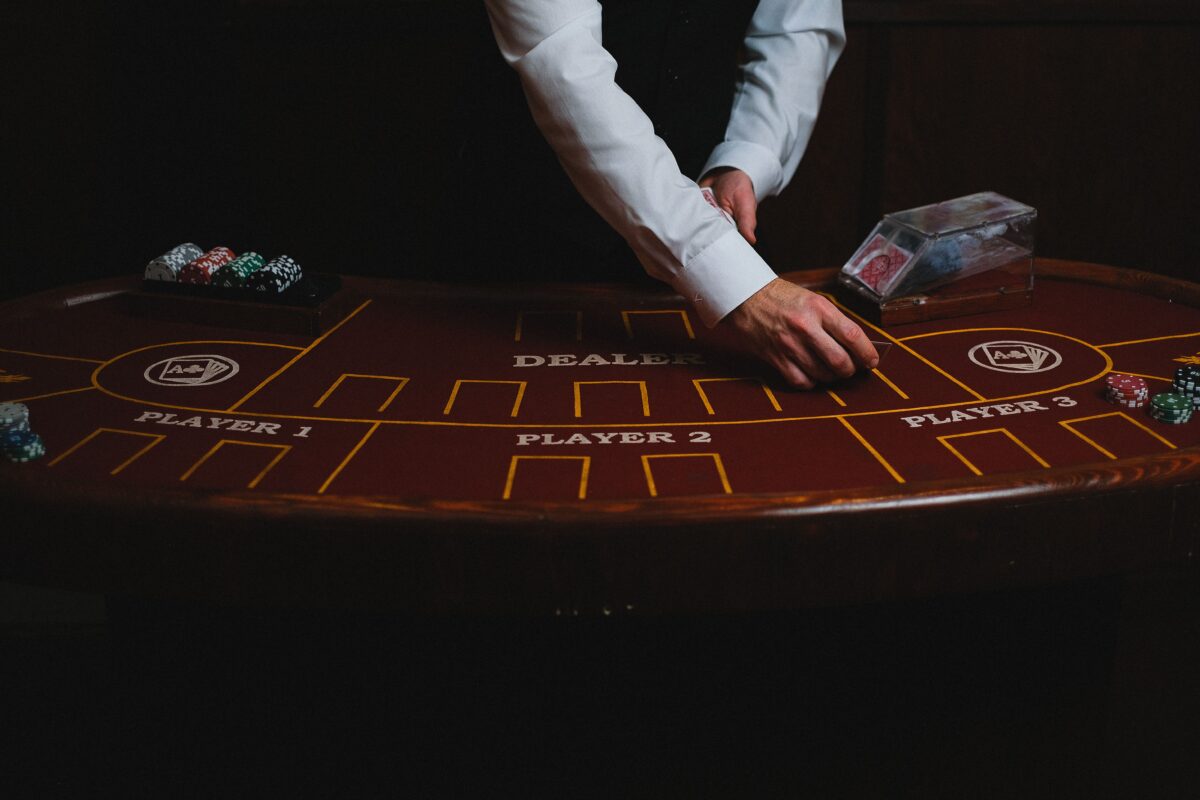
The shuffling-machine studies we found looked at casino equipment, not home shufflers. Photo by Anna Shvets on Pexels.
Stanford Magazine described a later evaluation in 2011: Diaconis, Susan Holmes and Jason Fulman examined a casino shuffler prototype and found that an experienced player could guess an upcoming card more easily than a well-randomized deal should allow. They advised shuffling twice. The manufacturer replied, “We are not pleased with your conclusions, but we believe them and that’s what we hired you for.” The team published the analysis in the Annals of Applied Probability in 2013 and wrote that their practical advice was adopted by the manufacturer.
Most home shufflers split the deck into two stacks and feed them into one tray. The FEIERYA 2-deck shuffler, for example, has two feeding slots and a press-and-hold button, and the ADZERD rechargeable shuffler has an automatic mode and a semi-auto mode that shuffles while you hold the button. Neither listing, nor any other listing in our card shuffler guide, publishes a randomness test.
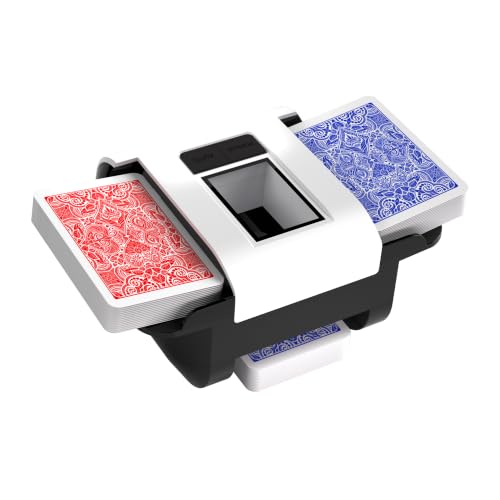
The ADZERD rechargeable shuffler, the Editor’s Choice in our card shuffler guide. Product image via Amazon.
Owner reviews point to the weak spots. FEIERYA owners report one side not feeding, which leaves one stack partly unmixed. CHH 6-Deck owners report the machine feeding too many cards at once, and some owners of Mattel’s UNO shuffler say it does not always mix the cards evenly. Owners of the ADZERD say it shuffles thoroughly without jamming.
Our take: treat one pass as a partial shuffle. Based on the riffle research and the casino-machine finding above, these steps get you closer to a well-mixed deck:
About seven riffle shuffles for a 52-card deck, according to the Bayer and Diaconis research summarized by Harvey Mudd College, which also notes that five shuffles are not enough to reverse a deck’s order. Overhand shuffling is much slower to mix, at about 2,500 shuffles for the same result. Larger decks, such as an UNO deck of 112 cards, are not covered by the 52-card figure.
Not after one pass, based on the research we found. A casino shuffling machine studied by Persi Diaconis’s team mixed a deck about as well as three riffle shuffles, while about seven riffles are needed for a 52-card deck. We found no published randomness test of home shufflers, so running the deck through twice is the safer habit.
They mix cards and save time, but how well varies by model. Owners of the ADZERD rechargeable shuffler say it shuffles thoroughly without jamming, while FEIERYA owners report cards getting stuck and one side not feeding. A machine that jams or feeds unevenly leaves part of the deck unmixed, so check owner reviews before buying.
At least twice, in our editorial view. When Diaconis and colleagues tested a casino shuffler that mixed about as well as three riffle shuffles, their advice was to run the cards through twice. No home shuffler maker we checked publishes a randomness figure, so two passes plus a cut is a reasonable routine for home games.
The research we found is about mixing quality, not cheating. Diaconis, Holmes and Fulman found that one casino shuffler prototype did not mix well enough after one pass, and the manufacturer adopted their advice, according to their 2013 paper and Stanford Magazine. We found no source showing that casino shufflers are designed to cheat players.
Riffle shuffle a 52-card deck about seven times, according to the Bayer and Diaconis research. Overhand shuffling alone takes about 2,500 shuffles for the same result. With a home shuffler, run the deck through at least twice and add a cut or hand riffle between passes.
A 52-card deck can be arranged in 52 factorial (52!) ways, about 8.07 x 10^67, according to Wikipedia. That is 52 x 51 x 50 and so on down to 1. Written out, that is a 68-digit number.
This guide is based on the Bayer and Diaconis shuffling research as summarized by Harvey Mudd College and Wikipedia, the Diaconis, Fulman and Holmes study of casino shuffling machines and its coverage in Science News and Stanford Magazine, and the Amazon listings and verified-purchase owner reviews for the shufflers in our card shuffler guide. Recommendations marked “Our take” are our editorial judgment based on the facts above.