
Kevin Zhang is a passionate table tennis coach and the founder of RecRoomPick.com, a site dedicated to helping players and enthusiasts discover the best in indoor games. With years of competitive ping pong experience, Kevin shares expert tips, equipment reviews, and guides on table tennis, foosball, pool, pickleball, darts, and more. His mission is to make indoor recreation fun, accessible, and competitive for everyone.

 Last updated: November 14, 2026
. Dimensions were checked against the NBA rulebook, the USA Basketball youth guidelines and the makers’ product pages. Recroompick earns a commission on qualifying purchases through the links on this page, at no extra cost to you.
Quick answer: A regulation basketball hoop is 10 feet (3.05 m) tall, measured from the floor to the top edge of the rim. The rim is 18 inches (46 cm) across on the inside, and a regulation backboard is 72 inches wide by 42 inches tall (6 x 3.5 ft) with a 24 x 18-inch inner rectangle, per the NBA rulebook. Youth guidelines from USA Basketball and the NBA lower the rim to 8 feet for ages 7 to 8 and 9 feet for ages 9 to 11, with 10 feet from age 12. Home hoops use smaller backboards (44 or 54 inches on the hoops in our guide), and most adjust between 7.5 and 10 feet. In our editorial view, a 54-inch adjustable hoop suits most family driveways. Compare models in our best portable basketball hoops guide.
Whether you are setting up a driveway hoop, lowering it for a child or checking a backyard court, the same few numbers come up: rim height, rim size and backboard size. The official numbers are simple, but home hoops differ from them in ways that matter when you buy.
This guide gives the regulation dimensions from the NBA rulebook, the recommended heights by age from the USA Basketball youth guidelines, and the real backboard sizes and height ranges of the home hoops we compared in our portable basketball hoops guide.
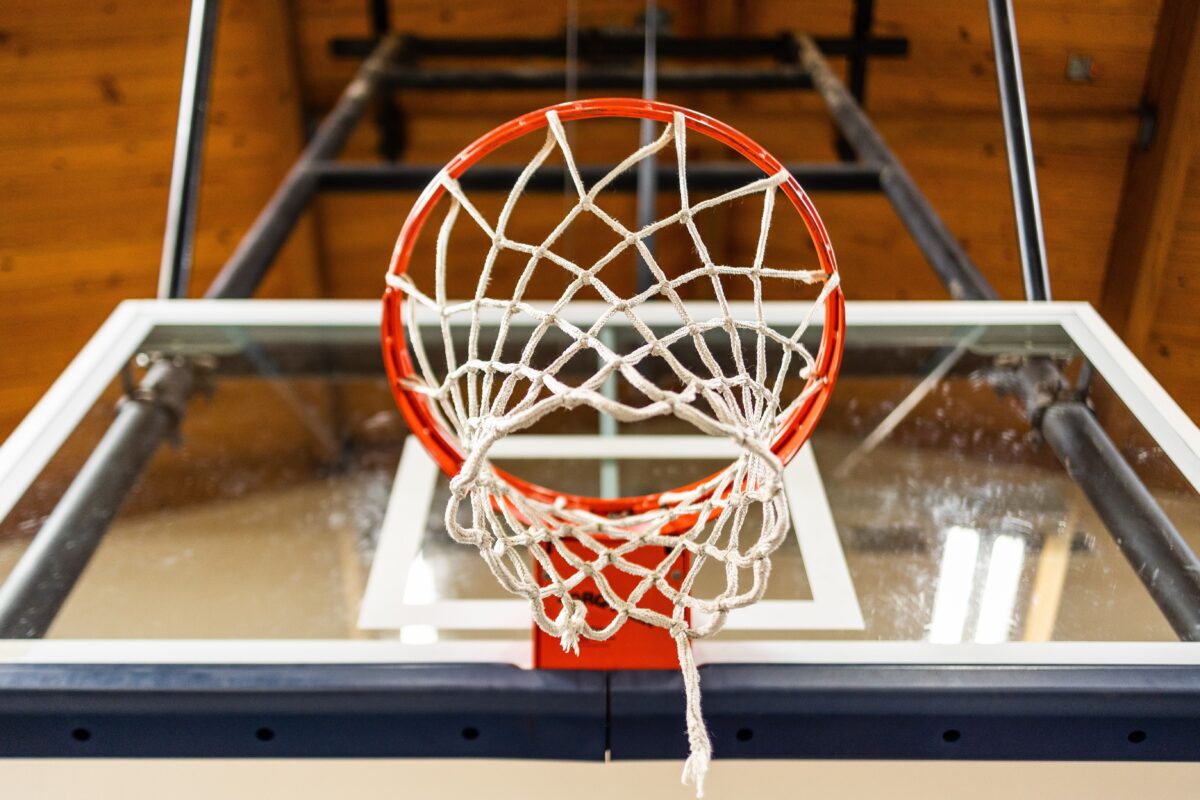
A regulation rim is 18 inches across inside and sits 6 inches out from the backboard, below the 24 x 18-inch inner rectangle. Photo by Caleb Oquendo on Pexels.
| Dimension | Regulation | Typical home hoop |
|---|---|---|
| Rim height | 10 ft (3.05 m) to the top of the rim | Adjustable, about 7.5 to 10 ft |
| Rim inside diameter | 18 in (46 cm) | 18 in on the Lifetime 44" (per Lifetime) |
| Rim to backboard | 6 in from the board to the inside edge of the rim | Varies by model |
| Net length | 18 in | Varies |
| Backboard | 72 x 42 in (6 x 3.5 ft), transparent | 44 or 54 in on the hoops in our guide; in-ground models up to 72 in |
| Inner rectangle | 24 x 18 in (61 x 46 cm) | Varies by model |
Sources: NBA Official Rule No. 1 (Court Dimensions and Equipment) and Wikipedia’s backboard article for metric values; home hoop figures from the maker pages and Amazon listings of the hoops in our guide (full list in the Sources section).
A regulation basketball hoop is 10 feet (3.05 m) tall. The NBA rulebook specifies the rim’s upper edge 10 feet above and parallel to the floor, and the same 10-foot height is used in USA Basketball’s guidelines from age 12 through high school.
The 10 feet is measured to the top of the rim, not to the top of the backboard. To check a home hoop, measure straight down from the front of the rim’s top edge to the playing surface.
A regulation rim is 18 inches (46 cm) in inside diameter. For comparison, a size 7 men’s ball has a 29.5-inch circumference, or about 9.4 inches across, so the rim is roughly twice as wide as the ball. The NBA rulebook also sets the net at 18 inches long and places the rim’s inside edge 6 inches from the face of the backboard.
A regulation backboard is 6 feet wide by 3.5 feet tall (72 x 42 inches; 1.83 x 1.07 m) and transparent, with a 24 x 18-inch inner rectangle above the rim. Home hoops use smaller boards: the Lifetime NBA League 44″ has a 44-inch board, and the Silverback NXT 54″, Lifetime 71524 and Spalding Momentous 54″ have 54-inch boards. Silverback’s 54-inch board measures 54 x 33 inches, per the Goalrilla store, and in-ground models from Goalrilla come in 54, 60 and 72-inch widths.
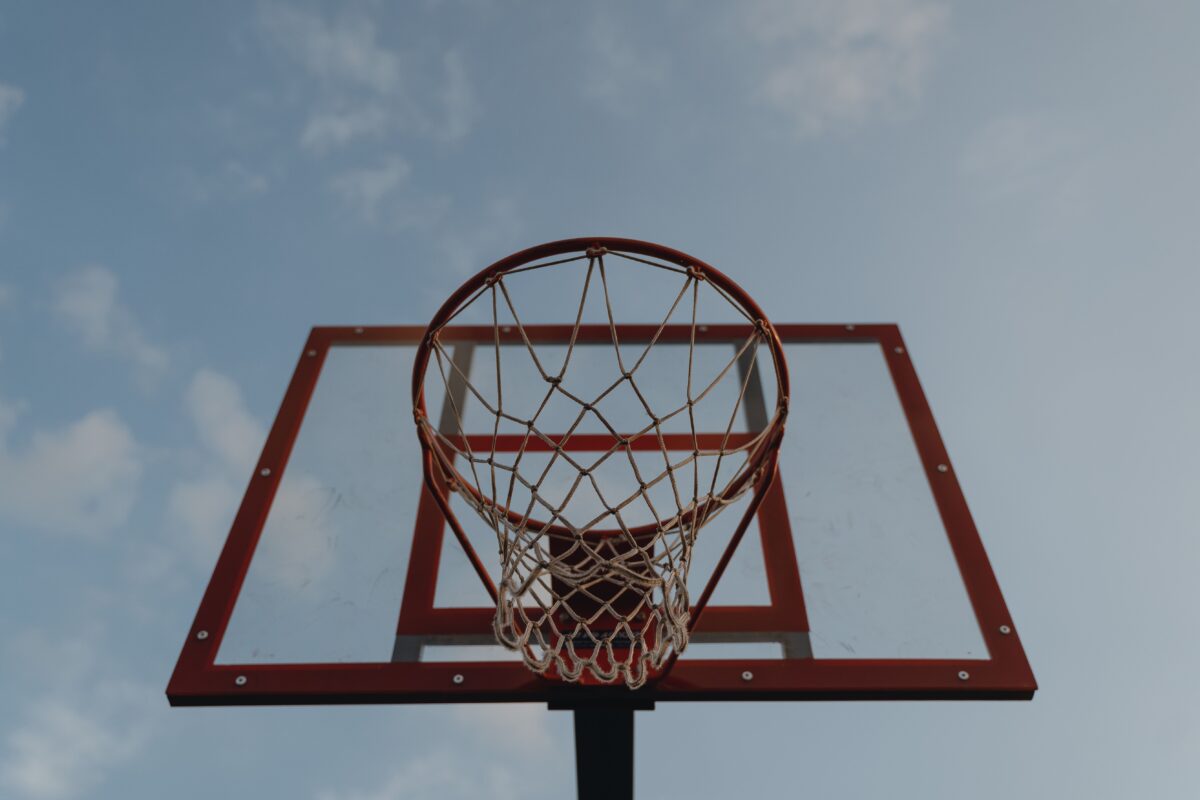
The inner rectangle is the target for bank shots; on a regulation board it measures 24 x 18 inches. Photo by Tima Miroshnichenko on Pexels.
USA Basketball’s youth guidelines, developed with the NBA, set the rim height and ball size by age:
| Age | Rim height | Ball size |
|---|---|---|
| 7 to 8 | 8 ft | Size 5 (27.5 in) |
| 9 to 11 | 9 ft | Size 6 (28.5 in) |
| 12 to 14 | 10 ft | Girls size 6 (28.5 in), boys size 7 (29.5 in) |
| High school (grades 9 to 12) | 10 ft | Girls size 6 (28.5 in), boys size 7 (29.5 in) |
Sources: USA Basketball Youth Guidelines (Rules and Standards); NBA.com, “NBA and USA Basketball youth basketball rules” (March 20, 2018). Ball sizes are circumferences.
The guidelines say a lower basket for ages 7 to 11 helps children develop proper shooting form and makes more shots go in. The guidelines start at age 7; for younger children, a hoop that goes below 8 feet, such as the Best Choice Products kids’ hoop (rim 70.5 to 82.3 inches), keeps the game reachable.
Most full-size home hoops adjust from about 7.5 feet to the regulation 10 feet. In our guide, the Lifetime NBA League 44″, the Lifetime 71524 and the Silverback NXT 54″ all adjust from 7.5 to 10 feet, according to Lifetime and Escalade, and the Spalding Momentous 54″ adjusts from 8 to 10 feet, per its Amazon listing. That range covers every age group in the USA Basketball table, so one adjustable hoop can grow with a child from age 7 to adulthood.
Fixed-height hoops cannot be lowered: the Silverback NXT 54 Fixed Height wall mount, for example, stays at one height, per the Goalrilla store.
Our take: a 54-inch adjustable hoop suits most family driveways: it is big enough for bank shots and adjusts to every youth height. Choose a 44-inch hoop for casual play or a narrow driveway, and a 60 or 72-inch in-ground hoop if you have the space and want a board close to regulation. Make sure the hoop adjusts to 8 and 9 feet if children aged 7 to 11 will use it.
Prices rise with backboard size, from about $270 for a 44-inch portable hoop to $535 to $700 for 54-inch models; see our basketball hoop cost guide. Then compare specific models in our best portable basketball hoops guide or our in-ground hoops guide, or see indoor mini hoops for a bedroom or office.
An NBA hoop is 10 feet tall, measured from the floor to the upper edge of the rim, according to NBA Official Rule No. 1. USA Basketball’s youth guidelines use the same 10-foot height from age 12 through high school. Only the rim height is fixed; the backboard sits above and behind it.
A regulation basketball rim is 18 inches (46 cm) in inside diameter, per the NBA rulebook. That is about twice the width of a size 7 basketball, which has a 29.5-inch circumference, or about 9.4 inches across. Lifetime lists the same 18-inch rim size for its 44-inch NBA League portable hoop.
A regulation backboard is 72 inches wide by 42 inches tall (6 x 3.5 feet; 1.83 x 1.07 m) with a 24 x 18-inch inner rectangle, per the NBA rulebook. Home backboards are smaller: the hoops in our guide use 44 or 54-inch boards, and Silverback’s 54-inch board, for example, measures 54 x 33 inches.
Eight feet, according to USA Basketball’s youth guidelines, which recommend an 8-foot rim and a size 5 ball (27.5-inch circumference) for ages 7 to 8. Ages 9 to 11 move up to 9 feet and a size 6 ball, and the regulation 10 feet starts at age 12.
Nine feet. USA Basketball’s youth guidelines recommend a 9-foot rim and a size 6 ball (28.5-inch circumference) for ages 9 to 11, then the regulation 10-foot rim from age 12. An adjustable home hoop that covers 7.5 to 10 feet handles every step.
For most home driveways, yes. A 54-inch board is 18 inches narrower than the 72-inch regulation size, but it still leaves room for bank shots and it is the size used by three of the five hoops in our guide, including the Lifetime 71524 and Silverback NXT 54″. Serious players with space may prefer a 60 or 72-inch in-ground hoop.
Six inches. The NBA rulebook places the nearest point of the rim’s inside edge 6 inches from the face of the backboard. The rim itself is 18 inches across, so the front of the rim sits about 24 inches out from the board.
Regulation dimensions come from NBA Official Rule No. 1 (Court Dimensions and Equipment), with metric conversions from Wikipedia’s backboard article. Heights and ball sizes by age come from the USA Basketball Youth Guidelines table and NBA.com’s article on the guidelines. Home hoop backboard sizes and height ranges come from Lifetime’s and Escalade’s product pages, the Goalrilla store and the Amazon listings for the hoops in our portable hoops guide. Recommendations marked “Our take” or “in our editorial view” are our judgment based on these facts.