
Kevin Zhang is a passionate table tennis coach and the founder of RecRoomPick.com, a site dedicated to helping players and enthusiasts discover the best in indoor games. With years of competitive ping pong experience, Kevin shares expert tips, equipment reviews, and guides on table tennis, foosball, pool, pickleball, darts, and more. His mission is to make indoor recreation fun, accessible, and competitive for everyone.

 Last updated: November 12, 2026
. Rules were checked against the Laws of Table Tennis 2026-27 and prices on Amazon on this date. Recroompick earns a commission on qualifying purchases through the links on this page, at no extra cost to you.
Quick answer: Ping pong and table tennis are the same sport. “Table tennis” is the official name used by the ITTF, the Olympics and USA Table Tennis, while “ping pong” is the older, informal name, trademarked by a British maker in 1901. The difference people notice is formality, not the game: official table tennis follows the ITTF Laws (games to 11, serve changes every 2 points, regulation 2.74 x 1.525 m table), while casual ping pong often uses house rules. The table is the same too: a “ping pong table” and a “table tennis table” of regulation size are identical. Americans just prefer the casual name: “ping pong table” gets about 11 times as many US Google searches as “table tennis table” (74,000 vs 6,600 a month, DataForSEO, 2026). Our take: call it whatever you like at home, and use “table tennis” when you look for clubs, coaching or rules.
Ask a club player and you may hear that “ping pong” is what happens in a basement and “table tennis” is what happens in a club. Ask the rulebook and there is only one game. Both answers are right in their own way, and the gap between them matters when you buy a table, a paddle or a set of balls.
This guide explains where the two names come from, how official rules differ from typical house rules, and whether the equipment sold as “ping pong” is any different from equipment sold as “table tennis”. Every rule below is quoted from the Laws of Table Tennis 2026-27, and every product fact comes from the tables in our best ping pong tables guide.
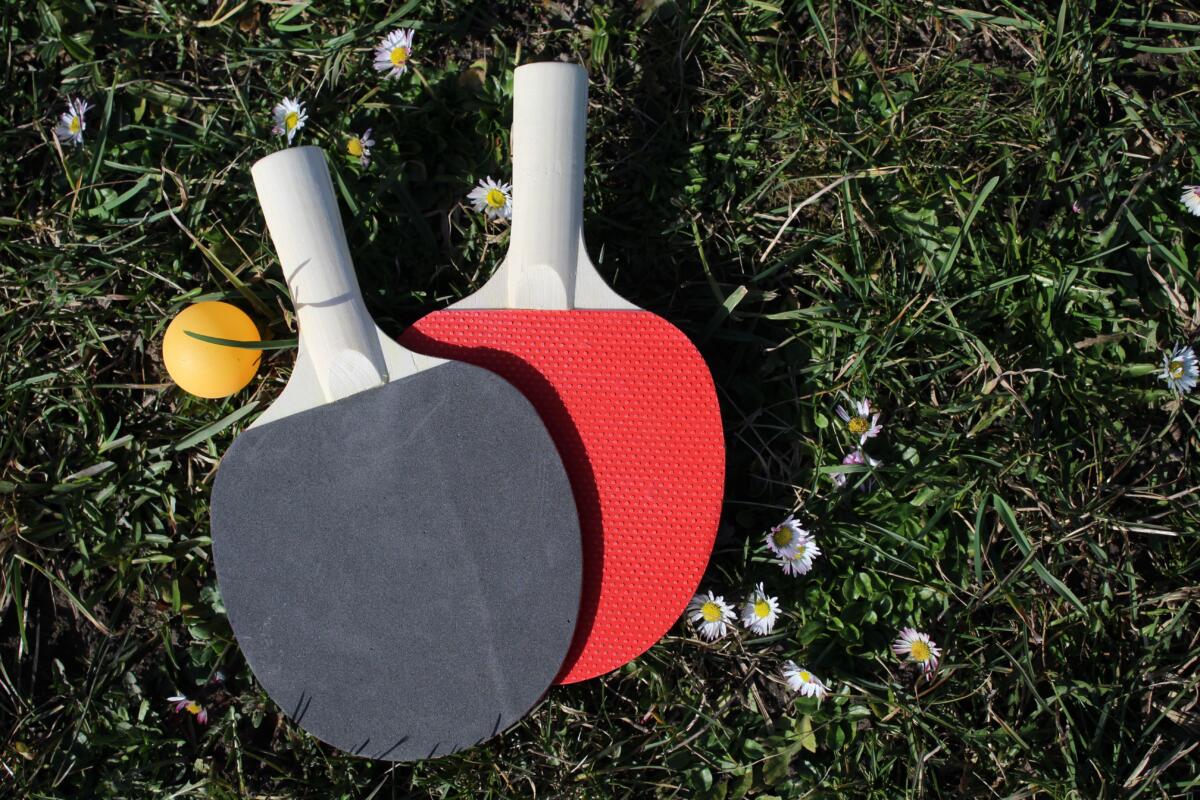
Ping pong and table tennis use the same kind of paddle: a wooden blade with rubber on each side. Photo by Kateryna Artamonova on Pexels.
| Casual “ping pong” | Official table tennis | |
|---|---|---|
| Name used by | Home players, bars, game rooms; most US shoppers | ITTF, Olympics, USA Table Tennis, clubs |
| Rules | House rules; these vary | Laws of Table Tennis (ITTF) |
| Game length | Often whatever the group agrees; some players still use the pre-2001 game to 21 | 11 points, win by 2 from 10-10; match is best of an odd number of games |
| Serve | Often relaxed | Ball tossed from an open palm, rising at least 16 cm (6.3 in); serve changes every 2 points |
| Table | Regulation or smaller (for example 72 x 36 in) | 2.74 x 1.525 m, 76 cm high, bounce of about 23 cm from a 30 cm drop |
| Paddle | Any; often a pre-made paddle; sandpaper in some events | Blade at least 85% natural wood; approved rubber, black on one side and a bright colour on the other |
| Ball | Any size or colour | 40 mm, 2.7 g, white or orange, matt |
Sources: Laws of Table Tennis 2026-27 (Table Tennis England, based on the ITTF Laws); Wikipedia, “Table tennis”. House-rule entries describe common variations, not a rulebook.
Yes. Ping pong and table tennis are the same sport played with the same table, net, ball and paddles; “table tennis” is simply the official name. The International Table Tennis Federation (founded in 1926), the Olympic Games (table tennis has been an Olympic sport since 1988) and the US governing body, USA Table Tennis, all use “table tennis”.
The practical difference is how seriously the game is played. In a club or tournament, players follow the Laws of Table Tennis to the letter. In a garage or game room, people often bend the rules: shorter or longer games, casual serves, any paddle that is lying around. That casual version is what many people mean when they say “ping pong”, but it is the same game.
It is called ping pong after the sound the ball makes on the table and paddle. Wikipedia notes that “ping-pong” is an onomatopoeia that “imitates the sound of the game”, and that the name was in wide use before the British maker J. Jaques & Son trademarked it in 1901.
Jaques later sold the rights to the “ping-pong” name to Parker Brothers, which enforced the trademark in the 1920s. The sport’s governing bodies use “table tennis”: the ITTF has carried that name since it was founded in 1926.
The difference is that table tennis has one official rulebook, while ping pong is often played with house rules. Under the Laws of Table Tennis 2026-27, these are the rules that matter most in practice:
You may still meet the 21-point game in casual play. The ITTF used 21-point games until it switched to 11 points in September 2001, and “table tennis rules 21 points” still gets about 320 US Google searches a month (DataForSEO, 2026), so the older format is still widely known. Neither is wrong at home; agree on the rules before the first serve.
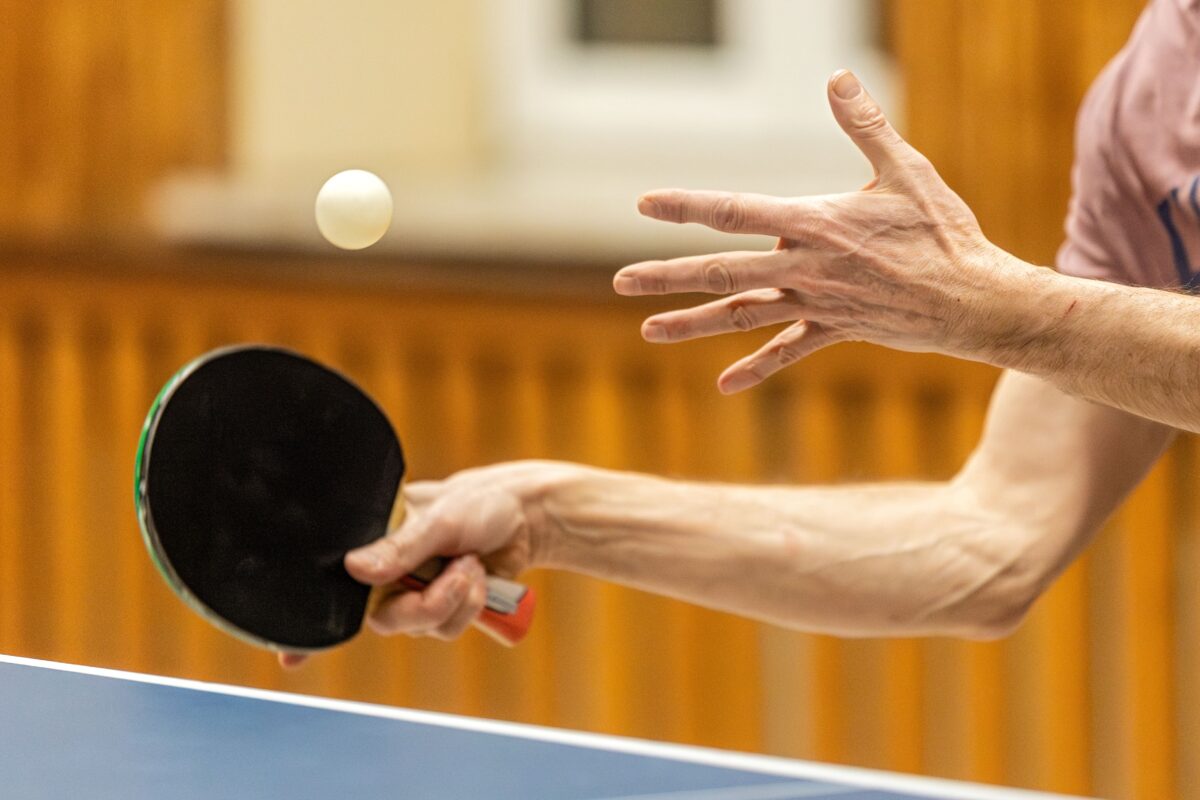
Under the official Laws, the serve starts from an open, flat palm and the ball must rise at least 16 cm. Photo by Oliver Wagenblatt on Pexels.
Yes. A regulation ping pong table and a regulation table tennis table are the same: 2.74 m long, 1.525 m wide and 76 cm high (about 9 x 5 ft and 30 in high), with a net 15.25 cm (6 in) high, per Laws 2.1.1 and 2.2.3. Makers use both names for the same product. JOOLA, STIGA and Cornilleau title their listings “table tennis table”, while US shoppers search for “ping pong table” about 11 times as often (74,000 vs 6,600 searches a month, DataForSEO estimates, 2026).
What actually separates tables is not the name but three specs:
Prices for each type are in our guide to how much a ping pong table costs.
Not by definition: “paddle”, “bat” and “racket” all name the same thing, and the Laws allow a racket of “any size, shape or weight” (Law 2.4.1). The difference is in the build. For official play, at least 85% of the blade’s thickness must be natural wood (Law 2.4.2), and each hitting side must be covered with pimpled rubber under 2.05 mm thick or sandwich rubber (sponge plus rubber) under 4.05 mm (Law 2.4.3), black on one side and a bright colour on the other (Law 2.4.6).
Casual ping pong often uses pre-made paddles, such as the 2 paddles included with the MD Sports Table Tennis Set ($275.00 on November 12, 2026). Two older styles are still played: hardbat, which Wikipedia describes as rackets with short outward pips and no sponge, giving less speed and spin, and sandpaper paddles, used at the World Championship of Ping Pong, an annual event first held in 2011, where the sandpaper is meant to slow the ball and lengthen rallies. Our guides to ping pong paddles for beginners and table tennis rubbers cover the options.
Yes, if they are the official size. The Laws require a spherical plastic ball 40 mm (1.57 in) across, weighing 2.7 g, in white or orange with a matt finish (Laws 2.3.1-2.3.3). The ITTF replaced the older 38 mm ball with the 40 mm ball in October 2000, so very old or novelty balls can be smaller. Check that a pack says 40 mm; our ping pong balls guide compares practice and tournament balls.
Use either one; they mean the same sport. In practice, the name helps you search:
Our take: the “ping pong vs table tennis” debate is about attitude, not equipment. A regulation home table, a decent paddle and 40 mm balls let you play either version on the same day.
Yes. Table tennis has been an Olympic sport since 1988, according to Wikipedia’s history of the sport. The Olympics, like the ITTF and USA Table Tennis, use the name “table tennis”, not “ping pong”, but it is the same game played in basements and game rooms.
Because “ping pong” was the popular name long before the official one. The word imitates the sound of the ball, and J. Jaques & Son trademarked “Ping-Pong” in 1901, later selling the rights to Parker Brothers. The governing bodies use the name “table tennis”, while many players, especially in the US, still say “ping pong”.
Yes, at regulation size both are 2.74 m long, 1.525 m wide and 76 cm high (about 9 x 5 ft and 30 in high), with a 15.25 cm net, under the Laws of Table Tennis. Some home tables sold as ping pong tables are smaller, such as the JOOLA Midsize at 72 x 36 inches, so check the dimensions on the listing.
Official table tennis is played to 11 points, and a player must lead by 2 points once the score reaches 10-10 (Law 2.11.1). Games were played to 21 until the ITTF changed the scoring in September 2001. Some people still play to 21 at home, which is fine as long as everyone agrees first.
Each player serves 2 points in a row, then the serve passes to the opponent (Law 2.13.3). Once the score reaches 10-10, players alternate after every point. In doubles, the previous receiver becomes the next server (Law 2.13.5). House rules vary, so agree on the rotation before a casual game.
At home, yes. In official play, the racket can be any size, shape or weight, but at least 85% of the blade must be natural wood, and the rubber must be under 2.05 mm (pimpled) or 4.05 mm (sandwich) thick, black on one side and a bright colour on the other (Laws 2.4.1-2.4.6).
Sandpaper ping pong is played with old-fashioned wooden paddles covered in sandpaper instead of rubber, meant to slow the ball and lengthen rallies. It has its own annual event, the World Championship of Ping Pong, first held in 2011. Sandpaper paddles are not legal under the Laws of Table Tennis, which require pimpled or sandwich rubber on a hitting side.
Rules are quoted from the Laws of Table Tennis 2026-27 published by Table Tennis England, based on the ITTF Laws, and checked on November 12, 2026. The history of the name, scoring and ball changes and the hardbat and sandpaper formats come from Wikipedia’s articles on table tennis and the World Championship of Ping Pong. Table, paddle and price facts come from the tables in our best ping pong tables guide, with prices checked on Amazon on November 12, 2026. Search volumes are DataForSEO estimates of average monthly US Google searches in 2026. Recommendations marked “Our take” are our editorial judgment.