

Kevin Zhang is a passionate table tennis coach and the founder of RecRoomPick.com, a site dedicated to helping players and enthusiasts discover the best in indoor games. With years of competitive ping pong experience, Kevin shares expert tips, equipment reviews, and guides on table tennis, foosball, pool, pickleball, darts, and more. His mission is to make indoor recreation fun, accessible, and competitive for everyone.

 Last updated: November 16, 2026
. Rules were checked against the American Darts Organization (ADO) tournament rules, DARTSLIVE and Wikipedia on this date. Recroompick earns a commission on qualifying purchases through the links on this page, at no extra cost to you.
Quick answer: Cricket darts is played on the numbers 20, 19, 18, 17, 16, 15 and the bull. Each player throws three darts per turn and needs three marks on a number to close it: a single counts as 1 mark, a double 2 and a treble 3. For the bull, the outer bull is 1 mark and the inner bull 2. Once you close a number, further hits score its points until your opponent closes it too. Under the American Darts Organization rules, the first player to close every number with the highest (or tied) score wins; if you close first while behind, you keep scoring until you catch up. In our editorial view, start on 20 and close the numbers your opponent is scoring on.
Cricket is one of the two game families in the American Darts Organization rulebook, next to the ’01 games (301, 501 and up). It plays differently: you race to claim numbers, score on them and shut down your opponent’s numbers at the same time.
This guide explains the standard (American) cricket rules step by step, with a scoring example, a score sheet layout and the cut-throat variant for three or more players. It is based on the ADO tournament rules, the DARTSLIVE rules page, Wikipedia’s article on the game and our research for the best dartboards guide.
| Rule | Standard cricket | Source |
|---|---|---|
| Numbers in play | 20, 19, 18, 17, 16, 15 and the bull (inner and outer) | ADO rule 49 |
| Darts per turn | 3 | ADO rule 19 |
| Marks per hit | Single 1, double 2, treble 3 | ADO rule 50 |
| Bull marks | Outer bull 1 mark, inner bull 2 marks | ADO rule 52 |
| Bull points | Outer bull 25, inner bull 50 | Wikipedia |
| Closing a number | 3 marks; then you score on it until your opponent also has 3 | ADO rules 50-51 |
| Order | Any order; calling your shot is not required | ADO rule 53 |
| Winning | Close all numbers first with the highest score; ties go to the first to close | ADO rule 55 |
Sources: ADO Tournament Rules booklet (American cricket rules 49-55), DARTSLIVE “CRICKET Game Rules”, Wikipedia “Cricket (darts)”. Full list in the Sources section.
Play goes like this, using the ADO rules for American cricket:
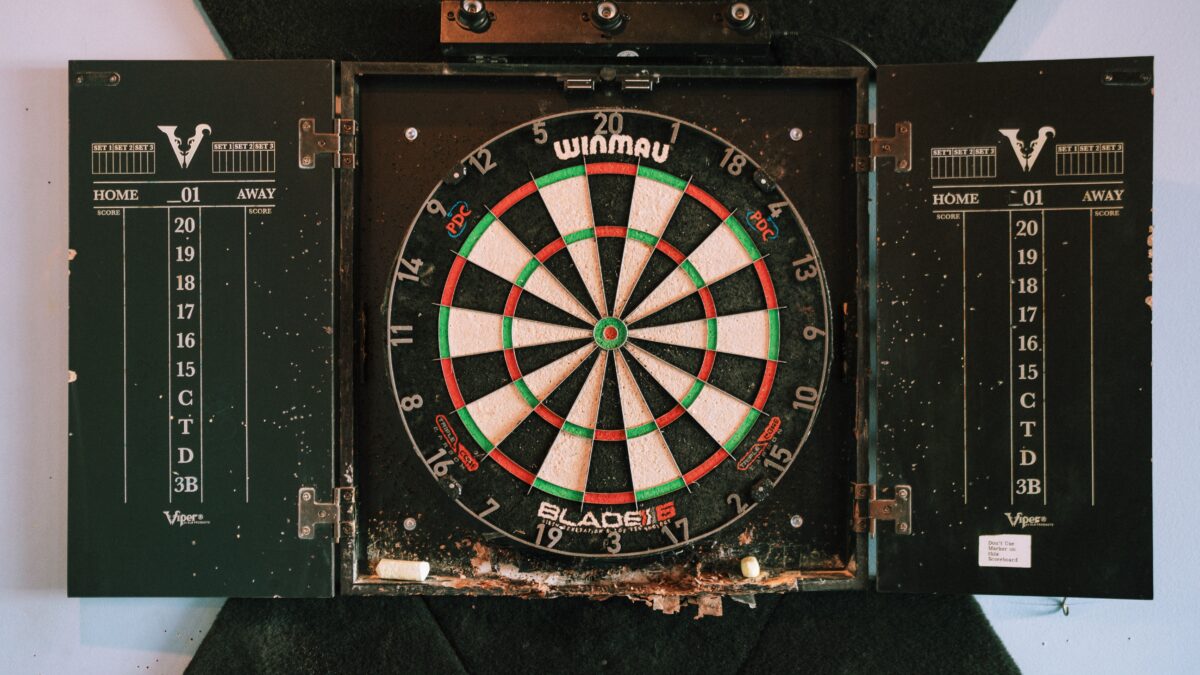
Some dartboard cabinets print a cricket column (20 down to 15) on the doors for keeping score. Photo by Sami Abdullah on Pexels.
Scoring has two parts: marks and points. Marks open and close numbers; points come only from extra hits on numbers you have closed and your opponent has not. ADO rule 51 says that once a player closes a number, “he/they may score points on that number until the opponent also closes that number,” with doubles and trebles counting two or three times the number’s value.
| Turn | Darts thrown | Marks | Points |
|---|---|---|---|
| Player A, turn 1 | Treble 20, single 20, single 19 | 20 closed (3 marks); 19 has 1 mark | 20 (the single 20 after closing) |
| Player B, turn 1 | Single 20, double 20, treble 19 | 20 closed, so 20 is dead for both; 19 closed | 0 |
| Player A, turn 2 | Double 19, single 18, outer bull | 19 closed, so 19 is dead; 18 has 1 mark; bull has 1 mark | 0 |
After two turns, Player A leads 20 to 0 but both players have work left on 18, 17, 16, 15 and the bull. Example by Recroompick, applying ADO rules 50 to 52.
To close the bull, the outer bull counts as one mark and the inner bull as two (ADO rule 52), so you need, for example, an inner bull and an outer bull. Once the bull is closed, extra hits score 25 for the outer bull and 50 for the inner bull, according to Wikipedia’s summary of the game. On electronic boards, DARTSLIVE notes that “an inner Bull is a double” in cricket.
ADO rule 55 sets three conditions:
Electronic boards can add a round limit: DARTSLIVE’s rules say the player with the highest score “when all numbers are closed or at the round limit” wins. Check your board’s manual for the number of rounds.
Write 20, 19, 18, 17, 16, 15 and B down the middle of a board or sheet, with one column for each player or team and a points column beside it. Wikipedia describes the usual marks: a slash (/) for the first mark, turning it into an X for the second, and a circle around the X for the third, which shows the number is closed.
| Player A points | Player A marks | Number | Player B marks | Player B points |
|---|---|---|---|---|
| 20 | (X) closed | 20 | (X) closed | |
| (X) closed | 19 | (X) closed | ||
| / | 18 | |||
| 17 | ||||
| 16 | ||||
| 15 | ||||
| / | Bull |
The sheet above shows the scoring example after Player A’s second turn. ADO rule 54 makes each player responsible for checking their score before pulling their darts; arithmetic must be corrected before the next player throws.
Cut-throat cricket uses the same numbers and marks, but points work in reverse. Wikipedia describes it this way: “points are undesirable; hitting a number that is opened results in points being given to any other players who do not have that number closed, and the lowest score wins.” In our editorial view it suits games with three or more players, because everyone can work against the leader.
Our take (strategy, not rules):
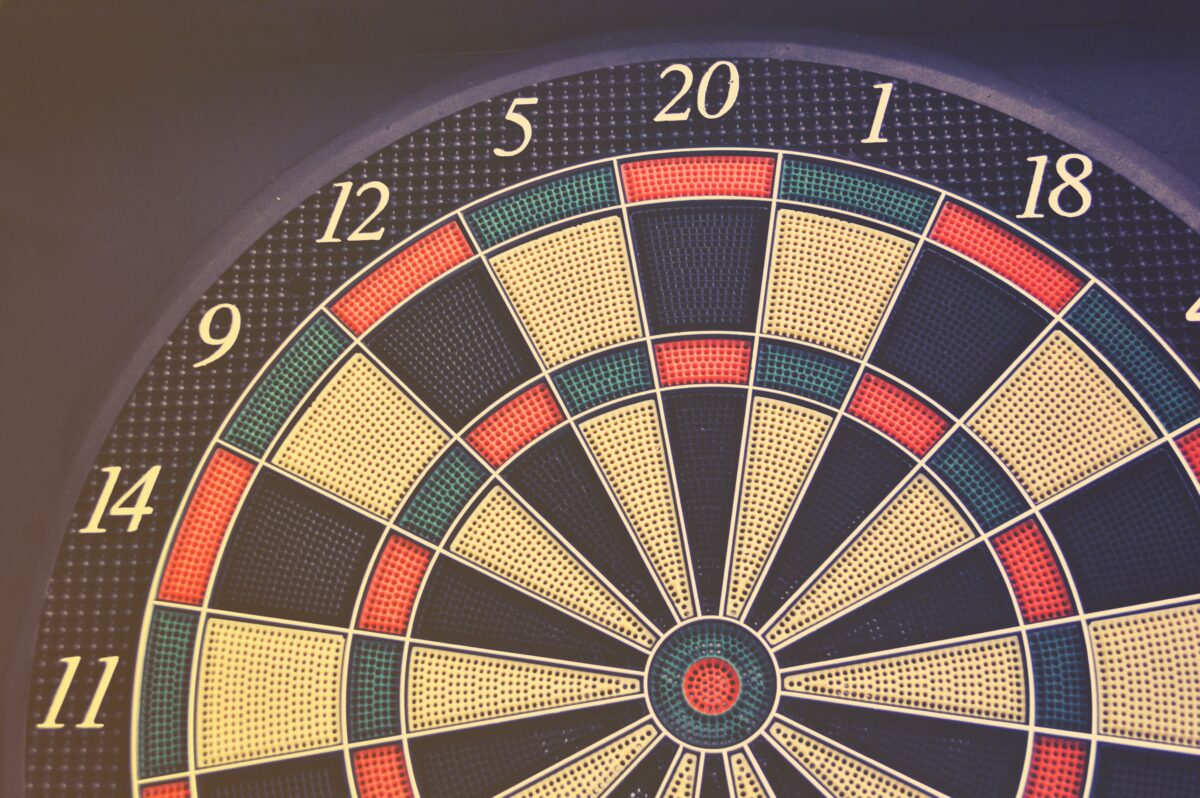
Electronic boards track cricket marks and points automatically. Photo by Stephen Niemeier on Pexels.
Electronic boards keep the marks and points for you, which takes the arithmetic out of cricket. In our best electronic dart boards guide, the Arachnid Cricket Pro 800 lists 40 games with 179 variations and a 15.5 in target, and cost $249.99 at our check. For steel-tip cricket on a bristle board, the Winmau Blade 6 in our best dartboards guide cost $89 at our check, and a dart scoreboard keeps the marks.
Only 20, 19, 18, 17, 16, 15 and the bull, according to ADO rule 49. Darts that land on 1 to 14 do not count for marks or points. You need three marks on each of the seven targets to close it, and you can close them in any order without calling your shot.
For closing the bull, the outer bull counts as one mark and the inner bull as two marks (ADO rule 52). Once you have closed the bull, extra hits score 25 points for the outer bull and 50 points for the inner bull, according to Wikipedia’s summary of cricket scoring.
No. Under ADO rule 55, the player who closes all numbers first must also have the higher score or a tie. If you close everything while behind, you must keep scoring on any number your opponent has not closed until you catch up or your opponent closes all the numbers.
No. ADO rule 53 says numbers can be owned or closed in any order the player or team chooses, and calling your shot is not required. Starting with 20, the highest-scoring number, is a strategy choice, not a rule.
Cut-throat uses the same numbers and marks as standard cricket, but points count against players. When you score on a number you have closed, the points go to every other player who has not closed it, and the lowest score wins, according to Wikipedia. In our editorial view it suits three or more players.
List 20 to 15 and the bull down the middle and give each player a marks column and a points column. Mark the first hit with a slash, turn it into an X for the second and circle it for the third to show the number is closed, as described by Wikipedia.
Three darts per turn, as in other darts games; ADO rule 19 defines a turn as three darts unless the leg or match ends sooner. Players or teams alternate turns until someone closes all seven targets with the higher or equal score.
The rules come from the American Darts Organization Tournament Rules booklet (general rules and additional ADO American cricket rules 49 to 55), the DARTSLIVE cricket rules page and Wikipedia’s article on cricket darts for bull points, score-sheet marks and variants. The scoring example and score sheet were built by Recroompick from those rules. Board details come from the listings we verified for our dartboard and electronic dartboard guides. Recommendations marked “Our take” are our editorial judgment.


