
Kevin Zhang is a passionate table tennis coach and the founder of RecRoomPick.com, a site dedicated to helping players and enthusiasts discover the best in indoor games. With years of competitive ping pong experience, Kevin shares expert tips, equipment reviews, and guides on table tennis, foosball, pool, pickleball, darts, and more. His mission is to make indoor recreation fun, accessible, and competitive for everyone.

 Last updated: November 15, 2026
. Figures were checked against the published shuffling research, Harvey Mudd College and Wikipedia on this date. Recroompick earns a commission on qualifying purchases through the links on this page, at no extra cost to you.
Quick answer: Shuffle a standard 52-card deck about seven times with riffle shuffles. Mathematicians Dave Bayer and Persi Diaconis showed in 1992 that after seven riffles every order of the deck is nearly equally likely, while five are not enough. For games where suits do not matter, such as blackjack, about four riffles are enough, according to Wikipedia’s summary of the research. Overhand shuffling is much weaker: it takes about 2,500 overhand shuffles to randomize a 52-card deck (Harvey Mudd College). A 52-card deck has about 8.07 x 10^67 possible orders (Wikipedia), a 68-digit number. In our editorial view, seven riffles and a cut is a simple routine for any suited game at home.
Three or four quick shuffles can feel thorough, but the math behind card shuffling says a deck keeps part of its old order for longer than you might expect, and that matters most in games where suits count.
This guide explains the seven-shuffle rule, why overhand shuffling falls short, how many shuffles larger decks need, and how big 52 factorial really is. It is based on the Bayer and Diaconis research as summarized by Harvey Mudd College and Wikipedia, a later rule-of-thumb paper by Diaconis and colleagues, and our research for the best card shuffler guide.
| Situation | Shuffles needed | Source |
|---|---|---|
| 52-card deck, suited game (bridge, poker, rummy) | About 7 riffle shuffles | Bayer and Diaconis, 1992 |
| 52-card deck, suits do not matter (blackjack) | About 4 riffle shuffles | Wikipedia summary |
| 52-card deck, overhand shuffles only | About 2,500 overhand shuffles | Harvey Mudd College |
| Larger decks | Grows slowly: about 1.5 more riffles each time the deck size doubles (estimate) | Our calculation from the 3/2 log2(n) formula |
| Casino shuffling machine studied (one pass) | Mixed about as well as 3 riffles | Science News, 2002 |
Sources: Harvey Mudd College, Wikipedia, Assaf, Diaconis and Soundararajan, Science News (full list in the Sources section).
About seven riffle shuffles for a standard 52-card deck. Harvey Mudd College summarizes the 1992 result of Bayer and Diaconis: “After seven random riffle shuffles of a deck of 52 cards, every configuration is nearly equally likely.” Wikipedia’s summary adds that the deck “did not start to become random until five good riffle shuffles”.
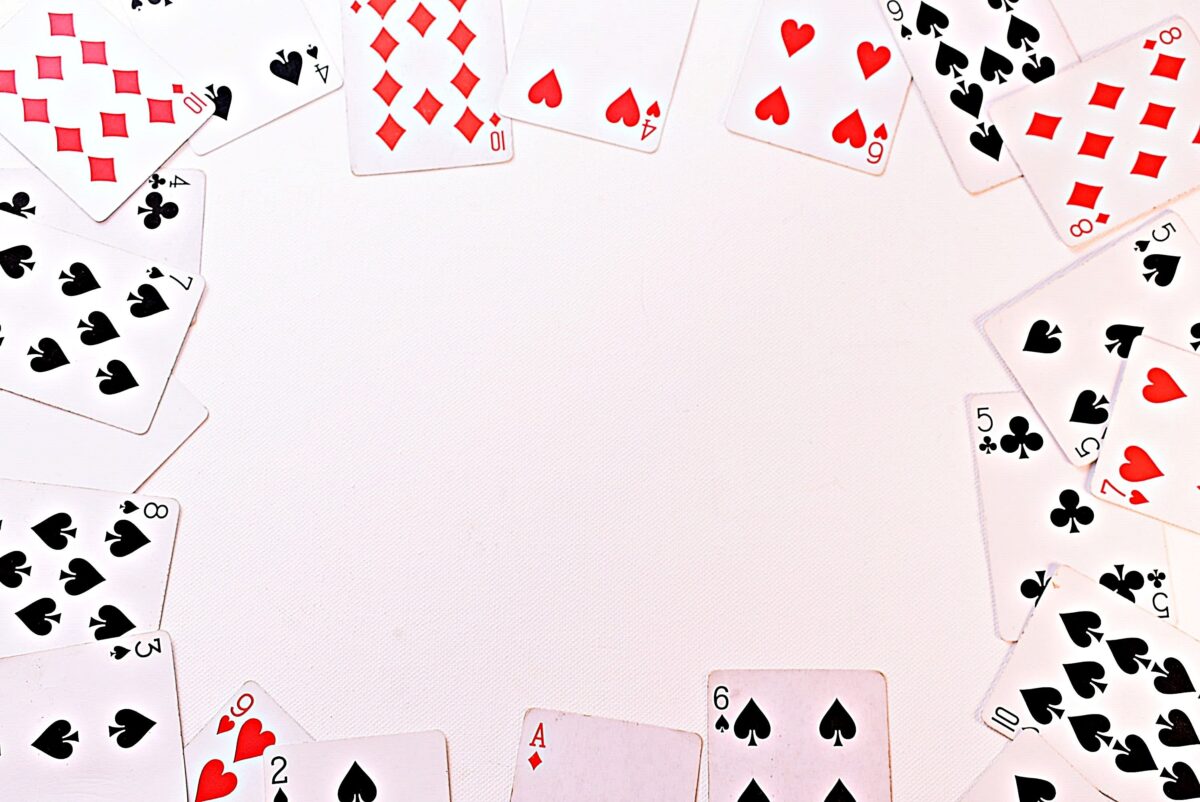
Seven riffle shuffles make every order of a 52-card deck nearly equally likely. Photo by Diana on Pexels.
Fewer shuffles leave traces of the old order. That is why Wikipedia’s summary of the research recommends seven riffles for suited games, where the order of suits matters, but only four for unsuited games like blackjack.
It depends on what you need to be random. The seven-shuffle answer is for every card’s exact position. When only some features matter, fewer shuffles do. A 2011 paper by Sami Assaf, Persi Diaconis and K. Soundararajan found that when suits are disregarded or only colors matter, the number of shuffles needed drops from about 3/2 log2(n) to log2(n) for an n-card deck. Wikipedia’s summary puts it simply: four riffles for unsuited games like blackjack, seven for suited games.
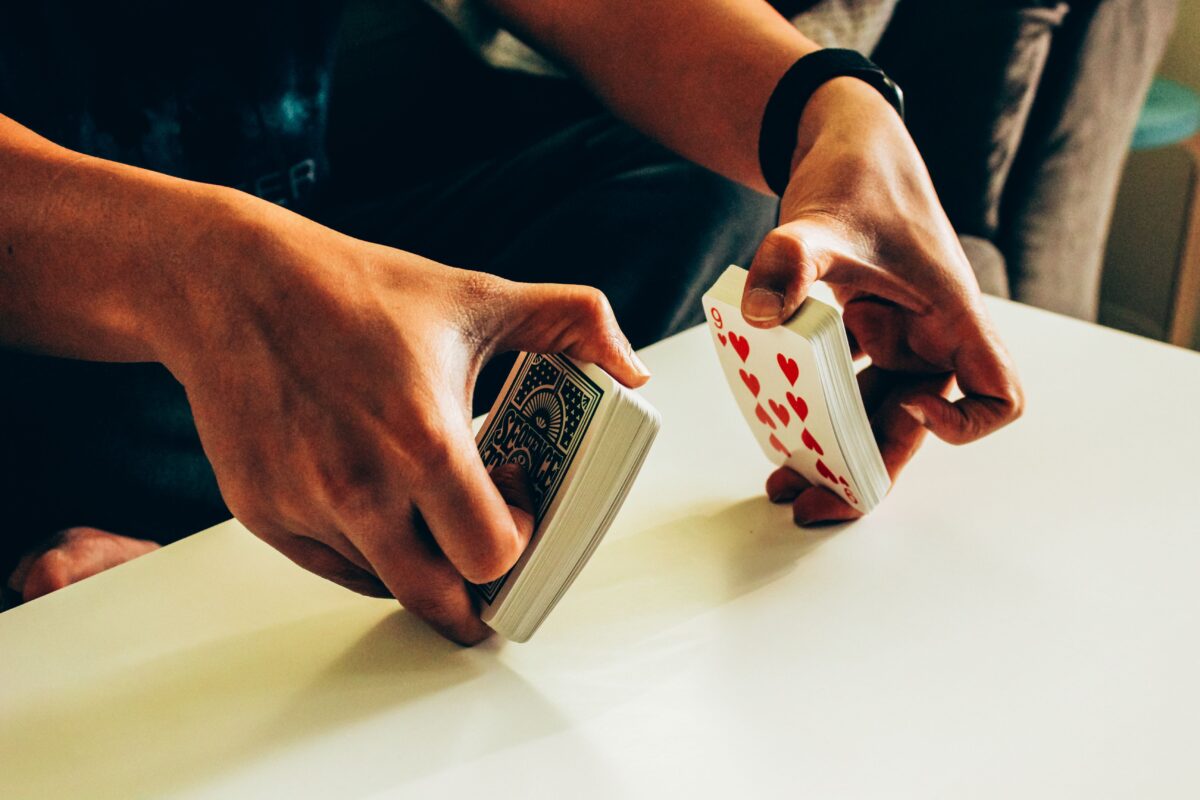
A riffle shuffle splits the deck and interleaves the two halves. Photo by Prathyusha Mettupalle on Pexels.
Our take: if you only overhand shuffle, add riffles or a card shuffler. Overhand shuffling alone will not mix a deck well in any reasonable time.
More cards need more shuffles, but not many more. The research formula for an n-card deck grows with log2(n), so doubling the deck adds about 1.5 riffle shuffles by that formula. By our estimate, a two-deck game (104 cards) or an UNO deck (112 cards) needs one or two more riffles than a single 52-card deck. Treat that as a guide, not an exact count: the published seven-shuffle result is for 52 cards.
If a big deck is awkward to riffle by hand, a machine can help. Our guide to card shufflers that work with UNO covers the 112-card UNO deck, and our best card shufflers include 6-deck models such as the CHH 6-Deck shuffler.
A 52-card deck can be put in 52 factorial (52!) orders: 52 x 51 x 50 and so on down to 1. Wikipedia gives the result as about 8.0658 x 1067. Written out, it is a 68-digit number.
A popular claim says there are more ways to order a deck than atoms in the universe. That is not right for the whole universe: Wikipedia estimates about 1080 atoms in the observable universe, roughly a trillion times more than 52!. It is still far more orders than anyone could ever shuffle through.
A card shuffler saves time but does not change the math. When Diaconis’s team tested a casino shuffling machine, one pass mixed the deck about as well as three riffle shuffles, and they advised running the cards through twice (Science News, 2002). We found no published randomness test for home shufflers; see are card shufflers random? for the details.
Our take: run the deck through a home shuffler at least twice, and add a cut or hand riffle between passes. Our Editor’s Choice, the ADZERD rechargeable shuffler, takes up to 2 decks per cycle and cost about $30 at our check.
About seven riffle shuffles for a standard 52-card deck. Bayer and Diaconis showed in 1992 that after seven riffles every order is nearly equally likely, while five are not enough. For games where suits do not matter, such as blackjack, about four riffles are enough, according to Wikipedia’s summary of the research.
No. 52 factorial is about 8.07 x 10^67, while Wikipedia estimates about 10^80 atoms in the observable universe, roughly a trillion times more. The comparison is often stated the other way round, but 52! is still a 68-digit number of possible deck orders.
About 2,500 for a 52-card deck, according to Harvey Mudd College’s summary of the research. That is why overhand shuffling alone mixes a deck poorly. Adding about seven riffle shuffles, or using a card shuffler for two passes, gets a well-mixed deck much faster.
Not by much for a 52-card deck. The research shows the deck goes from clearly ordered to nearly random between five and seven riffle shuffles, so seven is the practical point where more shuffling adds little. Larger decks need a little more: by the research formula, about 1.5 extra riffles each time the deck size doubles.
No one can check, but the numbers make a repeat very unlikely for a well-shuffled deck. A 52-card deck has about 8.07 x 10^67 possible orders, a 68-digit number. Decks that are only lightly shuffled are a different matter, because they keep much of their previous order.
At least twice, in our editorial view. A casino shuffling machine tested by Diaconis’s team mixed about as well as three riffle shuffles in one pass, and the advice was to run the cards through twice (Science News, 2002). No home shuffler we checked publishes a randomness test.
This guide is based on the Bayer and Diaconis research as summarized by Harvey Mudd College and Wikipedia, the rule-of-thumb paper by Assaf, Diaconis and Soundararajan, Wikipedia’s estimate of atoms in the observable universe, and Science News reporting on a casino shuffling machine. Shuffler details come from the listings we verified for our card shuffler guide. Estimates for larger decks are our calculation from the published formula, and recommendations marked “Our take” are our editorial judgment.