
 Last updated: November 17, 2026
. Measurements were checked against the World Darts Federation (WDF) Playing and Tournament Rules and GLD Products’ setup guide on this date. Recroompick earns a commission on qualifying purchases through the links on this page, at no extra cost to you.
Quick answer: A standard bristle dartboard is 451 mm (17.75 in) in diameter. Under the WDF specification, the scoring area measures 340 mm (13.39 in) across the outside of the double wires. The double and treble rings are 8 mm (0.31 in) wide inside the wires, the outer bull is 31.8 mm (1.25 in) across and the bull 12.7 mm (0.5 in). The numbers run clockwise 20, 1, 18, 4, 13, 6, 10, 15, 2, 17, 3, 19, 7, 16, 8, 11, 14, 9, 12, 5. The bull’s center hangs 1.73 m (5 ft 8 in) high, with the steel-tip throw line 2.37 m (7 ft 9.25 in) away (WDF rules, 2018 edition). In our editorial view, any board sold as WDF-approved will match these sizes.
Dartboard size questions usually come up for one of two reasons: you are planning wall space for a board and surround, or you want to know whether a board, especially an electronic one, matches the official size.
This guide lists every official measurement in millimeters and inches, explains the number order and compares the sizes of real bristle and electronic boards. It is based on the World Darts Federation rules, GLD Products’ setup guide and the product specs we verified for our best dartboards guide.
| Measurement | Metric | Inches | WDF tolerance |
|---|---|---|---|
| Overall board diameter | 451 mm | 17.75 in | +/- 3.0 mm |
| Outside double wire to outside double wire | 340 mm | 13.39 in | +/- 0.5 mm |
| Center to outside of double wire | 170 mm | 6.69 in | +/- 0.2 mm |
| Center to outside of treble wire | 107.4 mm | 4.23 in | +/- 0.2 mm |
| Double and treble ring width (inside wires) | 8 mm | 0.31 in | +/- 0.2 mm |
| Outer bull (25) inside diameter | 31.8 mm | 1.25 in | +/- 0.3 mm |
| Bull (50) inside diameter | 12.7 mm | 0.5 in | +/- 0.2 mm |
| Wire thickness | 1.27 to 1.85 mm | 0.05 to 0.07 in | +/- 0.2 mm |
| Height, floor to bull center | 1.73 m | 5 ft 8 in | – |
| Throw line, steel tip | 2.37 m | 7 ft 9.25 in | – |
Sources: WDF Playing and Tournament Rules sections 4 and 6; inch values converted by Recroompick (1 in = 25.4 mm), throw line in inches from GLD Products.
A standard dartboard is a 451 mm (17.75 in) sisal bristle board divided into 20 numbered segments, with a treble ring, a double ring, an outer bull and a bull. The World Darts Federation’s specification also requires the bristle type, the “1 – 20” clock pattern and the darker 20 segment at the top center.
Only the scoring area counts for points. The outside of one double wire to the outside of the opposite double wire is 340 mm (13.39 in); the rest of the board, outside the doubles, scores zero and holds the number ring.
Boards made with flat strip dividers instead of round wire measure their doubles and trebles apex to apex at 10 mm, according to the WDF rules.
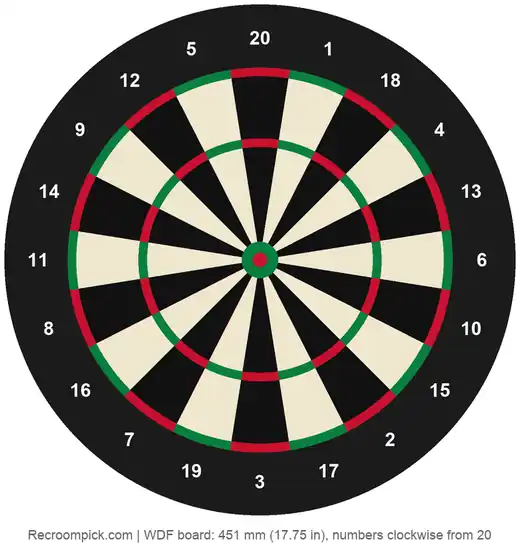
Standard dartboard layout, with the darker 20 segment at the top. Recroompick diagram drawn to the WDF specification.
Clockwise from the top, the numbers are 20, 1, 18, 4, 13, 6, 10, 15, 2, 17, 3, 19, 7, 16, 8, 11, 14, 9, 12, 5. This is the standard “clock” or London board listed in the OEIS number-sequence database (entry A104158). Each segment covers 18 degrees of the circle.
High and low numbers alternate so that a slightly missed throw is punished: the 20 sits between 1 and 5. Wikipedia attributes the layout to Lancashire carpenter Brian Gamlin in 1896 but notes this is disputed. Darts historian Patrick Chaplin argues that Gamlin probably never existed and that Yorkshireman Thomas Buckle has the strongest claim.
The WDF specification does not set a thickness. The two bristle boards we checked are both about 1.5 in (38 mm) thick: the Winmau Blade 6 is listed by Winmau at 450 mm across and 38 mm thick, and the Viper AIM 360 measures 17.75 x 17.75 x 1.5 in per GLD Products.
No. Electronic (soft-tip) boards come in several target sizes, and the outer case is larger than the target. The WDF bristle specification above does not cover them.
| Board | Type | Size | Price |
|---|---|---|---|
| Winmau Blade 6 | Bristle, WDF specification | 450 mm diameter, 38 mm thick | $89.00 |
| Viper AIM 360 | Bristle | 17.75 x 17.75 x 1.5 in | $55.82 |
| Arachnid Cricket Pro 800 | Electronic | 15.5-in target (Arachnid calls it regulation) | $249.99 |
| WIN.MAX electronic | Electronic | 13.5-in target | $72.59 |
| GRAN BOARD 3s | Electronic, Bluetooth | 22.5 x 22.5 x 1.625 in overall | $319.00 |
Sources: manufacturer spec pages (Winmau, GLD Products, Escalade/Arachnid, Gran Boards) and Amazon listings; prices checked November 11, 2026.
Soft-tip boards are also thrown from farther away. GLD Products gives 8 ft (2.44 m) for soft tip against 7 ft 9.25 in (2.37 m) for steel tip, both measured from the face of the board.
Hang the board so the center of the bull is 1.73 m (5 ft 8 in) above the floor, and place the throw line, or oche, 2.37 m (7 ft 9.25 in) from the face of the board for steel tip (WDF rules 6.01 and 6.02). To check your setup, measure the diagonal from the bull to the back of the throw line at floor level: 2.93 m (9 ft 7 3/8 in) for steel tip, or 2.98 m (9 ft 9.5 in) for soft tip (WDF rule 6.03; GLD Products).
Our step-by-step guide to hanging a dartboard covers mounting brackets, studs and lighting.
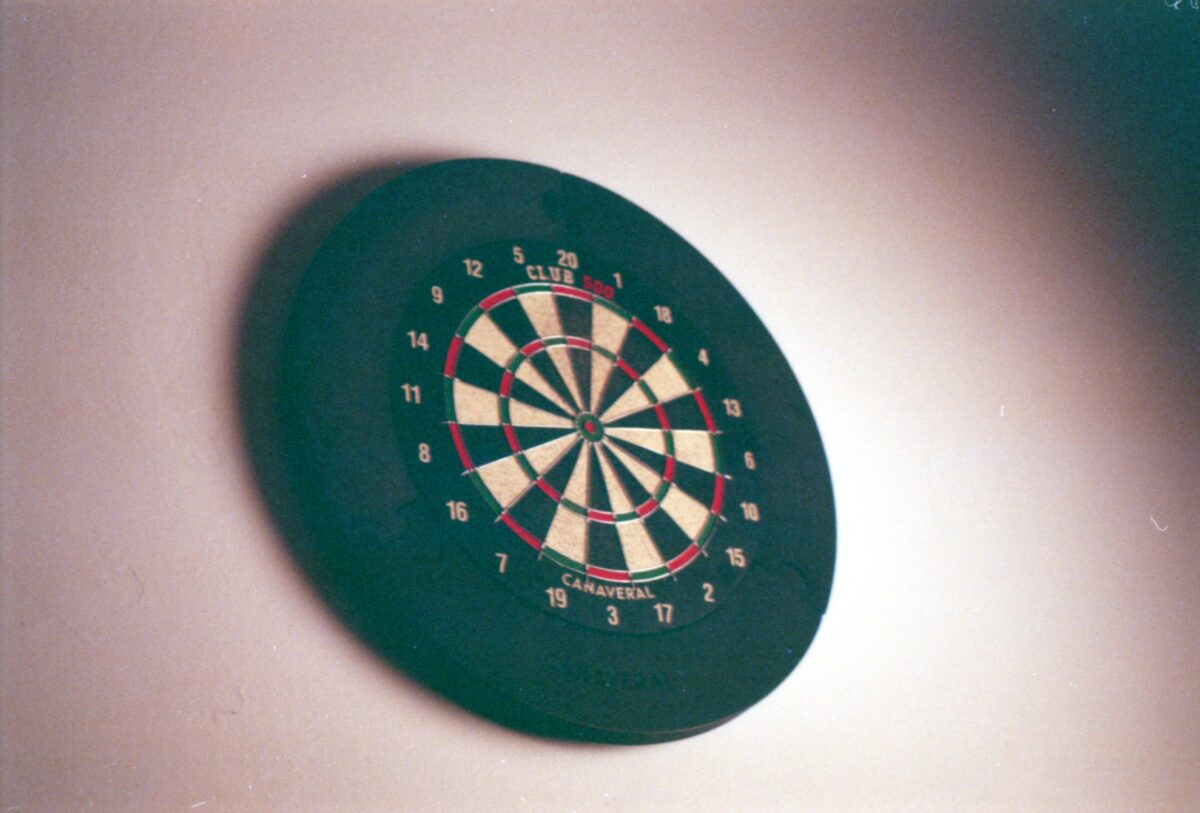
A bristle board inside a surround: the board stays 451 mm (17.75 in) across, while the surround adds a protective ring around it. Photo by Carlo Jünemann on Pexels.
A regulation bristle dartboard is 451 mm (17.75 in) in diameter, with a 340 mm (13.39 in) scoring area measured across the outside of the double wires. The double and treble rings are 8 mm wide, the outer bull 31.8 mm and the bull 12.7 mm, according to the World Darts Federation specification.
The center of the bullseye should be 1.73 m (5 ft 8 in) above the floor, measured at the same floor level as the throw line. That height comes from WDF rule 6.01 and is the same for steel-tip and soft-tip boards in GLD Products’ setup guide.
For steel-tip darts, the throw line is 2.37 m (7 ft 9.25 in) from the face of the board, not from the wall (WDF rule 6.02). For soft-tip electronic boards, GLD Products gives 8 ft (2.44 m). Measure along the floor, then check the diagonal from bull to throw line.
The same distance as a man. The WDF rules set one height of 1.73 m and one throw distance of 2.37 m for all players. Rule 6.08 only lets member bodies adjust height and throw line to suit the particular requirements of contestants in special events.
The 20 is at the top. The WDF specification says the 20 segment must be the darker of the two segment colors and sit at the top center. Reading clockwise from 20, the numbers are 1, 18, 4, 13, 6, 10, 15, 2, 17, 3, 19, 7, 16, 8, 11, 14, 9, 12 and 5.
Bristle boards made to the WDF specification are 451 mm (17.75 in) across, within plus or minus 3 mm. Electronic boards vary: the Arachnid Cricket Pro 800 has a 15.5-in target and the WIN.MAX board a 13.5-in target, per their listings, inside cases that are larger again.
The WDF specification sets no thickness. The bristle boards we checked are about 1.5 in (38 mm) thick: Winmau lists the Blade 6 at 38 mm, and GLD Products lists the Viper AIM 360 at 1.5 in. Allow for a mounting bracket that adds a little depth behind the board.
This guide is based on the World Darts Federation Playing and Tournament Rules (20th revised edition, February 2018), GLD Products’ official measurement guide, the OEIS entry for the dartboard sequence, Wikipedia and darts historian Patrick Chaplin. Product sizes come from the manufacturer pages and Amazon listings we verified for our best dartboards guide on November 11, 2026. Inch values are converted from the official millimeter figures. Recommendations marked “Our take” or “in our editorial view” are our editorial judgment based on the facts above.


