
Kevin Zhang is a passionate table tennis coach and the founder of RecRoomPick.com, a site dedicated to helping players and enthusiasts discover the best in indoor games. With years of competitive ping pong experience, Kevin shares expert tips, equipment reviews, and guides on table tennis, foosball, pool, pickleball, darts, and more. His mission is to make indoor recreation fun, accessible, and competitive for everyone.

 Last updated: November 14, 2026
. Specs were checked against the makers’ and retailers’ pages and the WPA equipment specifications, and prices come from Amazon listings for the tables in our pool table guides. Recroompick earns a commission on qualifying purchases through the links on this page, at no extra cost to you.
Quick answer: A slate pool table is worth it if you play often, want a surface that stays flat, and have room for a heavy table that stays put. Slate is natural stone, so it does not warp with humidity the way MDF and wood-composite beds can, and the World Pool-Billiard Association (WPA) specifies slate at least 1 inch (2.54 cm) thick in three equal pieces for tournament tables. The trade-offs are weight and price: the 8 ft Playcraft Charles River with 1-inch, 3-piece slate weighs about 700 lb and costs about $2,900, while the 7.5 ft Fat Cat Reno with a slate-alternative Accuslate bed weighs 313 lb and costs about $1,250. In our editorial view, a non-slate table is fine for kids, occasional play or a rental, and slate pays off for weekly players who plan to keep the table for years. Check the Charles River’s price on Amazon.
Slate is one of the biggest jumps in a pool table’s price. Two tables can look alike in photos, have the same cloth color and the same size, and still differ by $1,500 or more because one has a stone bed under the cloth and the other has engineered wood.
This guide explains what slate does, how it compares with MDF, Slatron and other slate alternatives, and what it costs in money, weight and moving effort. The figures come from the WPA equipment specifications, makers’ and retailers’ pages, and the tables we compared in our best pool tables guide.
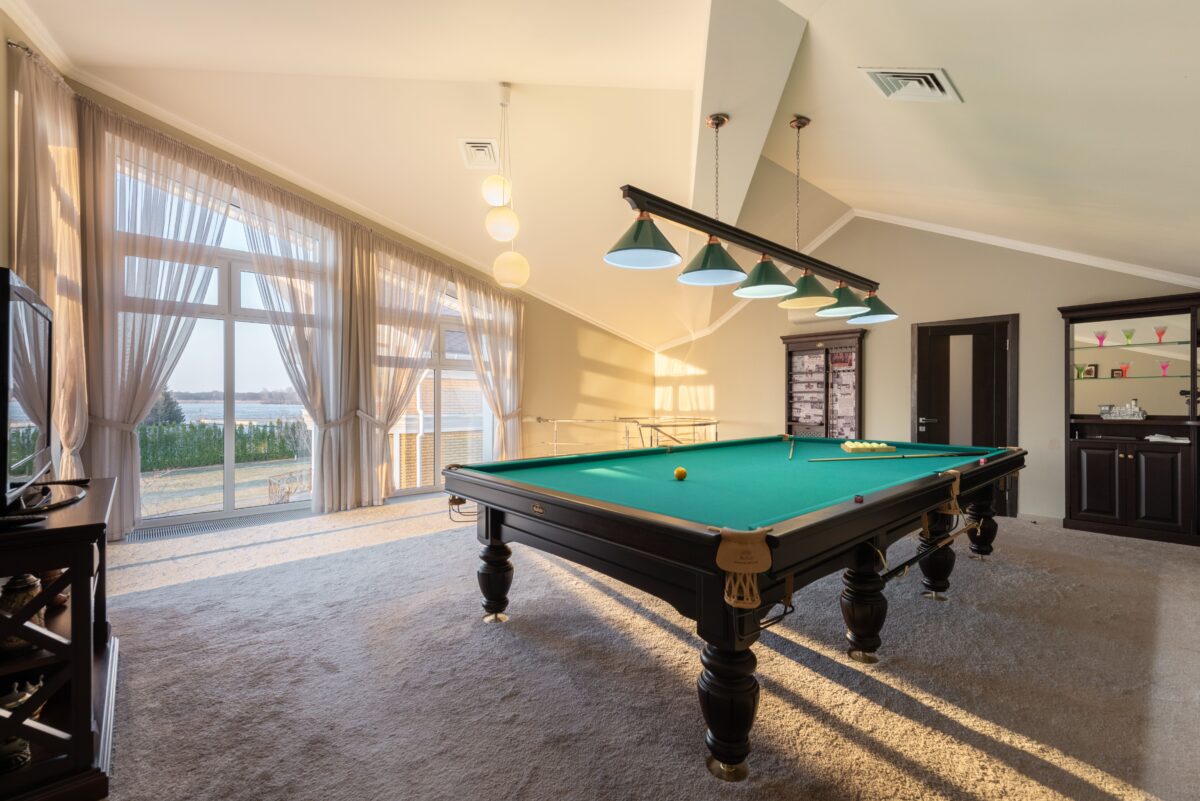
A full-size table is a long-term piece of furniture; the bed under the cloth decides how heavy it is and how well it stays level. Photo by Max Vakhtbovych on Pexels.
| Slate | Slate alternative (Slatron, Accuslate) | MDF / engineered wood | |
|---|---|---|---|
| What it is | Natural stone, honed flat | Man-made board; Slatron is resin-reinforced wood fiber (Escalade) | Wood-fiber board |
| Humidity | Does not warp the way wood does (Sawyer Twain) | Not stone; Slatron is wood-based | Can warp with humidity (Sawyer Twain) |
| Typical thickness | 3/4 in (entry) to 1-1/4 in; WPA: at least 1 in | 3/4 in on Escalade tables | Varies by table; often not listed |
| Example table | Playcraft Charles River 8′ | Fat Cat Reno 7.5′ | EastPoint Masterton 87″ |
| Weight of that table | About 700 lb (318 kg) | 313 lb (142 kg) | 187.8 lb (85 kg) |
| Price of that table | About $2,900 | About $1,250 | About $733 |
| Surface warranty | 5 years (retailer listing) | 7 years on the Accuslate surface (GLD) | See listing |
Sources: WPA Recommended Equipment Specifications, Escalade support, Sawyer Twain, the GLD Fat Cat Reno product sheet and Amazon listings (full list in the Sources section).
Yes, for regular players who want a table that plays the same way for years. The deciding facts are flatness and stability: slate is a solid stone that is honed flat and does not warp with changes in humidity or temperature the way wood and composite beds can, according to Sawyer Twain. That is also why the WPA’s equipment specifications call for slate in tournament play.
It is less clear-cut for casual use. A child learning the game, a family that plays a few times a year, or a rental home gets most of the fun from a non-slate table for a fraction of the price, without the 700 lb install. The test is simple: if you expect to notice a ball drifting off line, buy slate; if you won’t, the money is better spent on room, cues and lighting.
Pool tables use slate because it can be honed very flat and stays that way. On the Playcraft Charles River, for example, the 1-inch slate is framed and honed to 1/1000 of an inch, according to Sawyer Twain’s listing. Its weight also matters: Sawyer Twain notes that thicker slate adds stability and reduces vibration.
Sawyer Twain also states that nearly all professional tournaments and billiards organizations require slate-bed tables, which matches the WPA specification of slate at least 1 inch thick.
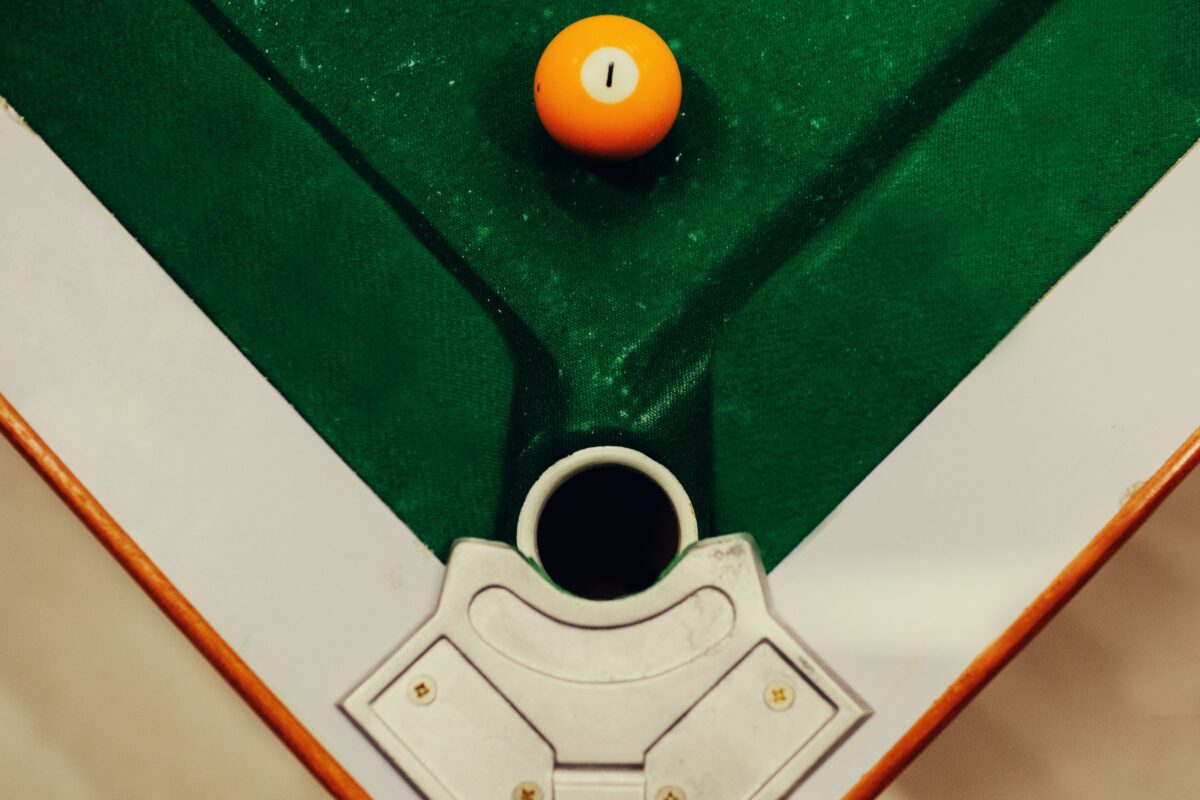
On a slow roll toward a pocket, a flat bed matters most: any dip or warp pulls the ball off line. Photo by Jonathan Borba on Pexels.
MDF and other engineered-wood beds are lighter and cheaper than slate but can warp with humidity, according to Sawyer Twain. Many of the budget and mid-price tables in our hub guide use them: the EastPoint Masterton 87″ has an engineered-wood bed and weighs 187.8 lb, and the Mizerak Dynasty Space Saver 6.5′ has a double-sealed MDF bed. Owner reviews of cheaper tables in our hub guide include reports of balls rolling toward the middle or the sides, a sign that the playing surface is not level.
Slatron is a brand-name slate substitute, not stone. Escalade, a table maker, describes Slatron as a man-made product constructed from resin-reinforced wood fibers, with a smooth playing surface 20 times denser than particleboard; on its tables, slate and Slatron beds are both 3/4 inch thick and cut identically. Sawyer Twain’s view is that Slatron and other composites cannot match the long-term performance of real slate.
Fat Cat’s Accuslate is a similar slate-alternative bed. The Fat Cat Reno 7.5′ uses it and carries a 7-year warranty on the Accuslate play surface (90 days on the rest of the table), per the GLD product sheet, which makes it the middle ground in our best pool tables guide.
Three-piece slate is the standard for home and tournament tables. The WPA specifies three pieces of equal size for tournament tables, and Sawyer Twain notes that three pieces make transport, installation and levelling easier and keep the table more stable over time.
When you compare listings, check the number of pieces, the thickness and whether the slate is framed (backed with wood), as on the Charles River.
For a table that meets tournament specifications, at least 1 inch (2.54 cm), per the WPA. Sawyer Twain describes 3/4-inch slate as entry level and fine for casual play, 1-inch as the standard for professional-grade tables, and 1-1/4-inch for premium tournament tables. Thicker slate is heavier and costs more; in our view, 3/4-inch slate is a reasonable compromise for a home table that will rarely be moved.
An 8 ft table with 1-inch, 3-piece slate weighs about 700 lb (318 kg): that is the figure for the Playcraft Charles River. Sawyer Twain estimates 500 to 700 lb for a standard 7 ft slate table and 800 to 1,200 lb for a 9 ft table. By comparison, the non-slate tables in our hub weigh 33 lb (a folding kids’ table) to 313 lb (the Fat Cat Reno).
The weight is one reason the retailer recommends professional installation for the Charles River, and moving a slate table means taking it apart. See how much a pool table weighs and how to move a pool table before you pick a room upstairs or plan a move.
In our price check, the 8 ft Playcraft Charles River with 1-inch, 3-piece slate cost about $2,900, while non-slate 6 to 7.5 ft home tables cost about $430 to $1,250. That makes slate roughly two to seven times the price of a non-slate home table in our set. Furniture-grade slate tables cost more and were outside the tables we price-checked.
Budget for professional installation and levelling on top of the price, because the retailer recommends it for the Charles River. Our pool table cost guide breaks prices down by size and bed type.
Our take: buy slate if you play weekly, want consistent rolls for practice, and will keep the table for years; the extra cost buys a surface that stays flat. Choose a slate alternative such as Accuslate if you want a warrantied surface and less weight at a mid-range price. Choose MDF for kids, casual play or a room you might repurpose. Before you buy, check the room against our pool table sizes and room size chart, and compare specific tables in our best pool tables guide or our pool tables under $1,000. Buying used? Learn how to tell if a pool table is slate.
For flatness and long-term play, yes. Slate is natural stone that does not warp with humidity, while MDF can, according to Sawyer Twain, and the WPA specifies slate for tournament tables. MDF is lighter and cheaper: an 87-inch engineered-wood table we checked weighs 187.8 lb and costs about $733, against about 700 lb and $2,900 for an 8 ft slate table.
Yes. Three-piece slate is what the WPA specifies for tournament tables, in three pieces of equal size and at least 1 inch thick. Splitting the bed makes the table easier to move, install and level, according to retailer Sawyer Twain. The 8 ft Playcraft Charles River, for example, uses 1-inch, 3-piece slate.
At least 1 inch (2.54 cm) for a table that meets tournament specifications, according to the WPA. Retailer Sawyer Twain lists 3/4-inch slate as entry level for casual home play, 1-inch as the professional standard and 1-1/4-inch for premium tournament tables. Thicker slate adds weight, stability and cost.
About 700 lb (318 kg) is a typical figure: the 8 ft Playcraft Charles River with 1-inch, 3-piece slate weighs about that much. Weight varies with slate thickness, the frame and the cabinet. Non-slate tables are far lighter; the 7.5 ft Fat Cat Reno with a slate-alternative bed weighs 313 lb.
Slatron is a slate substitute made from resin-reinforced wood fibers, not stone. Escalade, a table maker, says its Slatron surface is 20 times denser than particleboard and is cut to the same 3/4-inch thickness as its slate. Unlike slate, it is a wood-based board.
Slate can be honed very flat and keeps that flatness, because stone does not warp with humidity or temperature the way wood-based boards can. Its weight also makes the table more stable. That is why the WPA specifies slate at least 1 inch thick for tournament tables.
It depends on the floor and the access, so check both first. An 8 ft slate table weighs about 700 lb, and the slate pieces are carried in separately, so stairs and doorways must fit each slab. A professional installer can advise on the floor; if in doubt, a 300 lb slate-alternative table avoids the problem.
Slate thickness and piece standards come from the WPA Recommended Equipment Specifications. Material descriptions come from Escalade’s support page (slate vs Slatron) and Sawyer Twain’s buying guides on slate and slate thickness. Table weights, prices and warranties come from the GLD product sheet for the Fat Cat Reno, Sawyer Twain’s page for the Playcraft Charles River and the Amazon listings for the tables in our best pool tables guide. Recommendations marked “Our take” or “in our editorial view” are our judgment based on these facts.