
Kevin Zhang is a passionate table tennis coach and the founder of RecRoomPick.com, a site dedicated to helping players and enthusiasts discover the best in indoor games. With years of competitive ping pong experience, Kevin shares expert tips, equipment reviews, and guides on table tennis, foosball, pool, pickleball, darts, and more. His mission is to make indoor recreation fun, accessible, and competitive for everyone.

 Last updated: November 12, 2026
. Sizes were checked against the WPA equipment specifications and the makers’ and retailers’ pages. Recroompick earns a commission on qualifying purchases through the links on this page, at no extra cost to you.
Quick answer: The standard pool table sizes are 7, 8 and 9 ft. The name gives the approximate length of the playing surface: 100 x 50 inches for a 9 ft table, 92 x 46 for a pro 8 ft, 88 x 44 for a typical home 8 ft and about 76 x 38 for a 7 ft “bar box”, per the World Pool-Billiard Association (WPA) and Wikipedia. For the room, add one cue length to every side: with standard 58-inch cues, an 8 ft home table needs about 13 ft 4 in x 17 ft, a 7 ft table 12 ft 10 in x 16 ft and a 9 ft table 13 ft 10 in x 18 ft. Shorter cues shrink the room by about 1 ft (52-inch) to 1 ft 8 in (48-inch) each way. Our take: an 8 ft table suits most homes if the room allows it.
“8 ft pool table” sounds precise, but it isn’t: the name refers to the playing surface, not the table you have to fit through the door, and two “8 ft” tables can differ by several inches. What matters for your room is the playing surface plus enough space to swing a cue on every side.
This guide lists the standard sizes, explains what “regulation” and “bar size” mean, and gives a room-size chart for three cue lengths, worked out with the method behind Brunswick’s room chart. For specific tables, see our best pool tables guide.
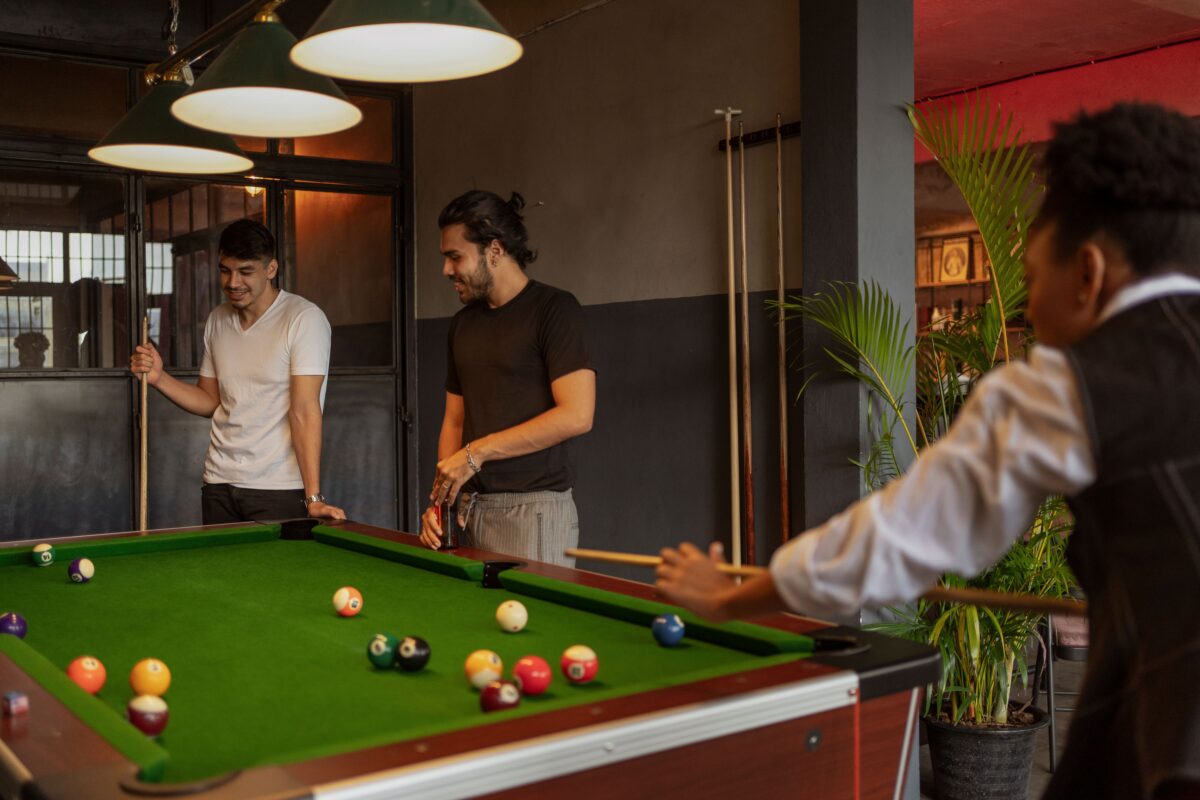
Plan the room around the table plus a full cue stroke on every side, not just the table’s footprint. Photo by Ketut Subiyanto on Pexels.
The standard pool table sizes are 7, 8 and 9 ft, with 6 ft tables common in homes and pubs. The playing surface, measured between the noses of the cushions, sets the size:
| Table size | Playing surface (in) | Playing surface (cm) | Notes |
|---|---|---|---|
| 6 ft | about 70-74 x 35-37 | about 178-188 x 89-94 | home and pub tables; e.g. GoSports 6 ft |
| 7 ft (“bar box”) | about 76 x 38 (74-78 x 37-39) | 193 x 96.5 | “bar box”; size varies by maker |
| 8 ft (home) | 88 x 44 | 224 x 112 | common home size; e.g. Playcraft Charles River |
| 8 ft pro (“8 ft+”) | 92 x 46 | 234 x 117 | WPA 8 ft size |
| 9 ft (tournament) | 100 x 50 | 254 x 127 | WPA 9 ft size |
Sources: WPA Recommended Equipment Specifications (8 ft and 9 ft), Wikipedia’s “Billiard table” (7 ft, metric) and Dr. Dave Pool Info (6 ft and 7 ft ranges, home 8 ft). 7 ft tables vary most between makers.
A regulation pool table under the WPA specifications is either 9 ft, with a 100 x 50 inch (254 x 127 cm) playing surface, or 8 ft, with a 92 x 46 inch (234 x 117 cm) surface. Its specifications set the bed height at 29 1/4 to 31 inches, require slate at least 1 inch thick and limit the rail width to 4 to 7 1/2 inches including the cushions.
Many home tables sold as “8 ft” are smaller than the WPA 8 ft size: the Playcraft Charles River 8′ has an 88 x 44 inch playfield, 4 inches shorter and 2 inches narrower than a pro 8 ft table.
A bar size pool table, or “bar box”, is a 7 ft table with a playing surface of about 76 x 38 inches, according to Wikipedia and Brunswick. Dr. Dave Pool Info gives a range of 74-78 x 37-39 inches and notes that 7 ft tables vary in size, so check the playfield on any listing. It is the smallest of the standard sizes; our guide to 7-foot pool tables compares home models.
You need the playing surface plus one cue length on every side. Brunswick says “enough space must be added to all sides of the table to allow for a full cue stroke”, and Dr. Dave adds about 6 inches for the backswing. Using that method, this chart shows the minimum room for each table size and cue length:
| Table (playing surface) | 58″ cue | 52″ cue | 48″ cue | Comfortable (58″ cue + 6″ backswing) |
|---|---|---|---|---|
| 6 ft (74 x 37 in) | 12’9″ x 15’10” | 11’9″ x 14’10” | 11’1″ x 14’2″ | 13’9″ x 16’10” |
| 7 ft (76 x 38 in) | 12’10” x 16′ | 11’10” x 15′ | 11’2″ x 14’4″ | 13’10” x 17′ |
| 8 ft home (88 x 44 in) | 13’4″ x 17′ | 12’4″ x 16′ | 11’8″ x 15’4″ | 14’4″ x 18′ |
| 8 ft pro (92 x 46 in) | 13’6″ x 17’4″ | 12’6″ x 16’4″ | 11’10” x 15’8″ | 14’6″ x 18’4″ |
| 9 ft (100 x 50 in) | 13’10” x 18′ | 12’10” x 17′ | 12’2″ x 16’4″ | 14’10” x 19′ |
Room = playing surface + 2 x cue length in each direction (our calculation). The 58-inch column matches Brunswick’s chart within about 2 inches, and the comfortable column matches Dr. Dave Pool Info’s minimum room sizes. In metric, with 58-inch cues: 8 ft home table about 4.06 x 5.18 m, 9 ft about 4.22 x 5.49 m.
Measure wall to wall, then subtract anything that sticks out where you would stand to shoot, such as a sofa, a bar counter or a door swing. In our view, a post or a short wall at one spot is usually workable, because few shots need the full cue length in that exact place.
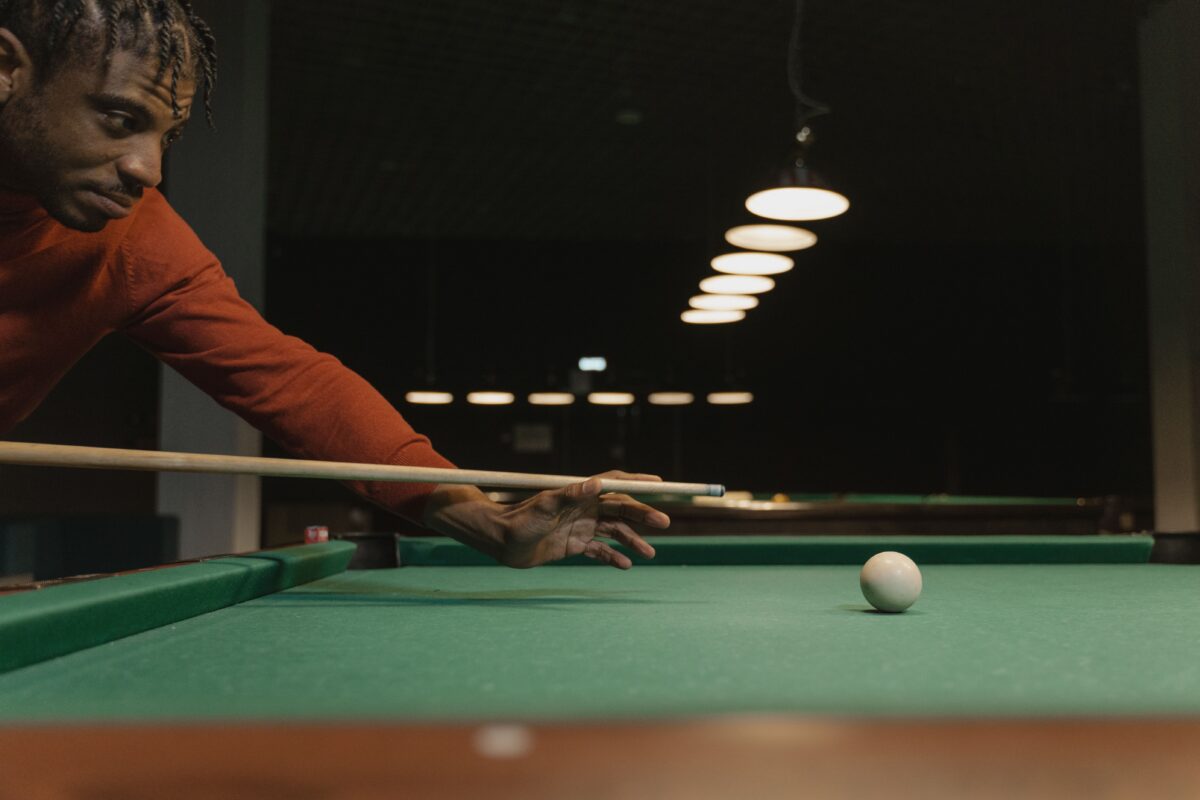
A standard cue is about 57 to 58 inches long, and you need that much space behind the cue ball on a rail shot. Photo by Tima Miroshnichenko on Pexels.
Use shorter cues, a smaller table, or both. Brunswick notes that “shorter cues can provide additional flexibility in rooms where wall clearance is limited”, and its chart drops from 13 x 17 ft to 11 ft 2 in x 15 ft for an 8 ft table with 48-inch cues. Dr. Dave Pool Info adds that many players find 52 or 48-inch cues less satisfying than standard 57-58 inch cues, so keep a short cue for the tight spots rather than for every shot.
A pool table is bigger than its playing surface because of the rails and cushions: 8 to 11 inches longer and wider in our examples. These are the outside dimensions of the tables in our best pool tables guide:
| Table | Outside size (L x W x H) | Notes |
|---|---|---|
| Costzon 47″ Folding Billiard Table | 47 x 26 x 29 in | kids’ folding table |
| Hathaway Spartan 6′ | 72 x 38 x 31 in | 64 x 30 in playfield; ping pong top |
| GoSports 6 ft | 76 x 43 x 31 in | GoSports recommends a 15 x 13 ft room |
| Mizerak Dynasty Space Saver 6.5′ | 78 x 44 x 32 in | ball return |
| EastPoint Masterton 87″ | 87 x 50 x 31 in | about 7 ft class |
| Fat Cat Reno 7.5′ | 89.5 x 50.5 x 31 in | slate-alternative surface |
| Playcraft Charles River 8′ | 99 x 55 x 32.5 in | 88 x 44 in playfield; 1-inch slate |
Sources: Amazon listings, the GLD product sheet (Fat Cat Reno) and Sawyer Twain (Charles River). Use the outside size for doorways and stairs, and the playing surface for the room chart. Our guide to how to measure a pool table shows where to measure.
A pool table’s playing bed sits 29 1/4 to 31 inches (74 to 79 cm) above the floor under the WPA specifications. The 6 ft and larger tables in our guide stand 31 to 32.5 inches tall to the top of the rails. For the light above it, see our guide to pool table light heights.
Our take: pick the largest table that leaves a full cue stroke on every side, and keep one short cue for the odd tight spot. Then compare models and prices in our best pool tables guide and our guide to how much a pool table costs.
The most common home size is an 8 ft table with an 88 x 44 inch playing surface, while the WPA’s regulation sizes are 9 ft (100 x 50 inches) and 8 ft (92 x 46 inches). 7 ft “bar box” tables are about 76 x 38 inches. Standard sizes are twice as long as they are wide, measured between the cushion noses.
An 8 ft home table (88 x 44 inch playing surface) needs about 13 ft 4 in x 17 ft with standard 58-inch cues, or 14 ft 4 in x 18 ft with 6 inches of backswing. With 52-inch cues it fits in about 12 ft 4 in x 16 ft, and with 48-inch cues 11 ft 8 in x 15 ft 4 in.
Not for home play, in our view. A 7 ft table has a playing surface of about 76 x 38 inches, the “bar box” size, and it needs about 12 ft 10 in x 16 ft with standard cues. Players who want practice for 8 or 9 ft tournament tables may prefer a larger table, since long shots get longer.
Get an 8 ft table if your room is at least about 13 ft 4 in x 17 ft, and a 7 ft table if it is closer to 12 ft 10 in x 16 ft (both with 58-inch cues). With 52-inch cues, an 8 ft table fits in about 12 ft 4 in x 16 ft. In our view, the bigger table is worth it when it fits.
Not a standard one. Even with 48-inch cues, a 6 ft table needs about 11 ft 1 in x 14 ft 2 in, so a 12 x 12 ft room is too short in one direction. Options are a small folding or mini table, or a tabletop game; our mini and portable pool table guides cover these.
Yes, for a 7 ft table with short cues. A 7 ft table with a 76 x 38 inch playing surface needs about 11 ft 2 in x 14 ft 4 in with 48-inch cues, and about 11 ft 10 in x 15 ft with 52-inch cues, so it just fits. An 8 ft table needs at least 15 ft 4 in of length even with 48-inch cues.
Choose 7 ft if the room allows about 12 ft 10 in x 16 ft with standard cues, or 11 ft 2 in x 14 ft 4 in with 48-inch cues. A 6 ft table’s playing surface is only about 2 to 6 inches shorter (70-74 inches vs about 76), so in our view it makes sense mainly for kids, combo tables or folding tables you store away.
Table sizes come from the WPA Recommended Equipment Specifications, Wikipedia’s “Billiard table” article and Dr. Dave Pool Info; room recommendations from Brunswick Billiards and Dr. Dave Pool Info. We calculated the room chart as playing surface plus two cue lengths in each direction and checked it against both sources. Outside dimensions of real tables come from the Amazon listings, the GLD product sheet and Sawyer Twain for the tables in our best pool tables guide. Recommendations marked “Our take” or “in our view” are our editorial judgment.