
 Last updated: November 17, 2026
. Rules were checked against the CueSight bumper pool rules, Wikipedia and the Triangle Billiards guide on this date. Recroompick earns a commission on qualifying purchases through the links on this page, at no extra cost to you.
Quick answer: In bumper pool, you win by sinking all five of your balls in the pocket at the far end before your opponent does. Two players (or two teams of two) play 5 red and 5 white balls. Each side has one marked ball, and you must pocket it before any of your other balls. Both players start at the same time by banking their marked ball off the cushion on their right. Sink your ball in the wrong pocket (the one at your end) and your opponent drops two of their balls in by hand; sink your last ball there and you lose (CueSight rules). Jump shots are not allowed. In our editorial view, practicing that opening bank shot is the quickest way to win more games.
Bumper pool looks like a small pool table with a cross of rubber posts in the middle and only two pockets. The rules are short, but they are rarely printed on the table, and house rules drift. The questions that come up most are about the opening shot, the marked ball and what happens when a ball goes in the wrong pocket.
This guide lays out the standard rules step by step, with the penalties in one table and two diagrams. It is based on the rules published by CueSight, Wikipedia’s description of the game, the Triangle Billiards guide and the table listings we checked for our best bumper pool tables guide.
| Rule | What happens | Source |
|---|---|---|
| Players | 2 players, or 4 in two teams of 2 | CueSight rule 1 |
| Balls | 5 per side (5 red, 5 white), one marked ball in each set | CueSight rule 2, Wikipedia |
| Setup | Balls on the spots by the pocket, marked ball directly in front of the pocket | CueSight rule 3, Wikipedia |
| Opening shot | Both marked balls shot at the same time, each off the cushion on the shooter’s right | CueSight rule 4 |
| Who goes first | The player whose marked ball stops closest to their scoring pocket | CueSight rule 5 |
| Turns | Keep shooting while you score; when you miss, your opponent shoots | CueSight rules 5-6 |
| Marked ball first | Score it before any other ball; otherwise opponent drops 2 balls | CueSight penalties 1 and 8 |
| Wrong pocket | Opponent drops any 2 balls by hand; with your last ball, you lose | CueSight penalties 7 and 9 |
| Ball off the table | Your ball goes to the center bumpers and your opponent shoots | CueSight penalty 4 |
| Jump shots | Not allowed | Wikipedia |
| Winning | First player or team to sink all their balls | CueSight rule 7 |
Sources: CueSight bumper pool rules, Wikipedia “Bumper pool” (full list in the Sources section).
Bumper pool is a two-pocket cue game played on a small rectangular or octagonal table with fixed, cushioned posts called bumpers. According to Wikipedia, the two pockets sit opposite each other in the middle of two rails, two bumpers flank each pocket, and the rest form a cross in the center, most often eight bumpers with two on each arm.
There is no white cue ball. You strike your own colored balls directly with the cue, which is the main difference from 8-ball. For how other cue games compare, see our guide to billiards vs pool vs snooker.
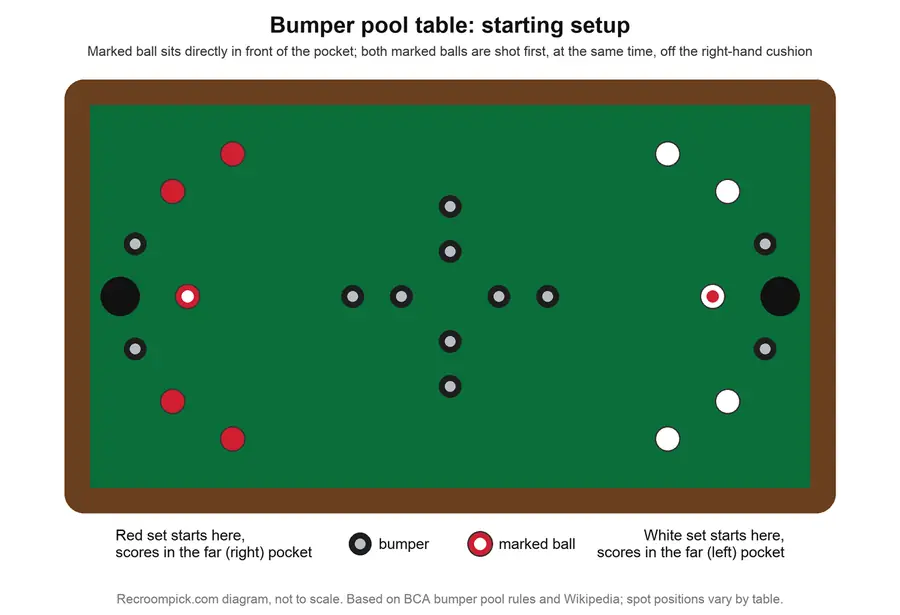
Starting setup: each set of five balls begins by one pocket and is played into the pocket at the far end. Recroompick diagram based on the CueSight rules and Wikipedia; spot positions vary by table.
Both players shoot their marked ball at the same time toward the far pocket, and each shot must hit the cushion on the player’s right (CueSight rule 4). Triangle Billiards suggests a countdown so the shots really are at the same time.
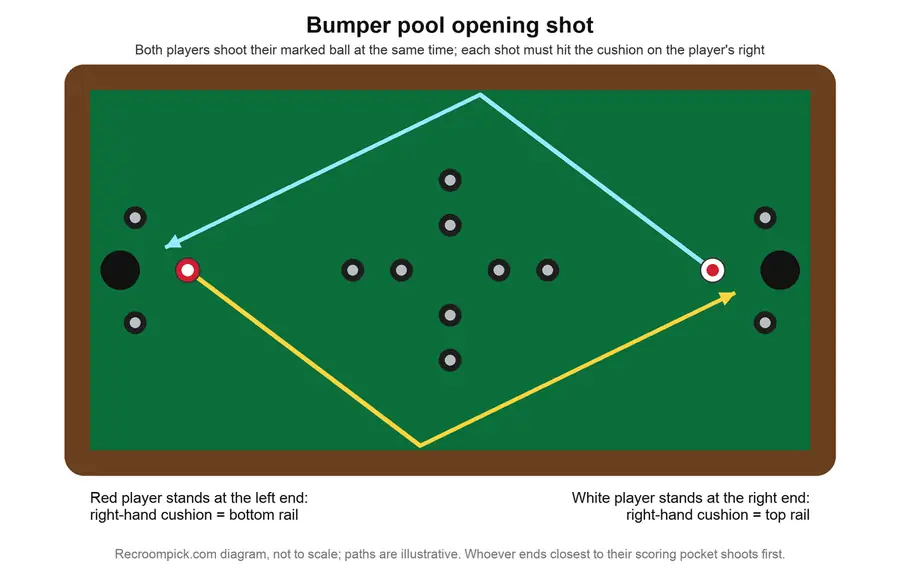
Opening shot: both marked balls are played at the same time and must hit the cushion on the shooter’s right. Recroompick diagram; paths are illustrative.
The player whose marked ball ends up closest to their scoring pocket shoots first. If that player sinks the marked ball, they keep shooting their other balls until they miss (CueSight rule 5). If both marked balls go in on the opening shot, both players shoot again using the ball to the left of the pocket (CueSight penalty 3).
You keep your turn as long as you score. When a shot scores nothing, your opponent plays (CueSight rule 6). You may hit your opponent’s balls: the CueSight tips recommend knocking an opponent’s ball out of a good scoring position and parking one of your balls in front of their pocket to block it.
The first player or team to sink all five balls wins (CueSight rule 7). Wikipedia calls sinking all five without the opponent getting a turn a perfect game.
The rules do not change on an octagonal table: the same 10 balls, two pockets and penalties apply. Octagon tables are often 3-in-1 designs with a smaller playfield. The Hathaway Kingston 3-in-1, for example, is a 48-in octagon with a 34.5-in octagonal bumper pool surface and retractable pockets under a reversible dining and poker top (Amazon listing). On a smaller playfield the opening bank is shorter, so agree before the game on which cushion counts as “right” if the table’s shape makes it unclear.
Bumper pool tables are smaller than regulation pool tables (Wikipedia). The rectangular tables in our roundup measure 54 to 57.5 in long and 39 to 41.5 in wide, and all six tables in our roundup come with two 48-in cues. Freetime Fun’s listing advises allowing about 7 x 9 ft of floor space for its 54 x 39-in table.
| Table | Overall size | Playing surface | Price |
|---|---|---|---|
| Hathaway Renegade (slate) | 54 x 39 in | 45.5 x 30 in, 3/4-in slate | $946.99 |
| Hathaway Renegade II | 54 x 39 in | 45 x 30 in, engineered wood | $779.75 |
| Atomic Classic | 57.5 x 41.5 in | 49.5 x 33.5 in, MDF | $731.99 |
| Valley Tiger Cat | 57 x 41 in | 3/4-in slate | $4,395.00 |
| Hathaway Kingston 3-in-1 | 48-in octagon | 34.5-in octagon | $928.25 |
Sources: Amazon listings, prices checked November 17, 2026. Full reviews of each table are in our bumper pool tables roundup.
Bumper pool uses only 10 balls and two pockets on a smaller table, so there is less to keep track of. It is not automatically easier: the bumpers deflect shots, and the penalty rules punish a ball in the wrong pocket hard.
Our take: bumper pool is the friendlier game for kids and mixed groups because there is no cue ball to scratch and every shot moves your own ball. Players used to 8-ball usually need a few games to learn the bank shots around the bumpers.
If you sink one of your balls in the pocket at your own end, which is your opponent’s scoring pocket, your opponent may drop any two of their balls into their pocket by hand, under the CueSight rules. If that ball was your last one, you lose the game immediately.
Hitting an opponent’s ball is legal, and the CueSight tips recommend it when their ball is close to scoring. If you sink their ball, it counts for them. If you knock it off the table, it goes back to its original spot and you place one of your own balls in the center bumpers.
Bumper pool uses 10 balls, two pockets and a smaller table, and there is no cue ball to scratch, so in our view it is quicker to learn than 8-ball. The bumpers make bank shots tricky, though, and a ball in the wrong pocket hands your opponent two free balls under the CueSight rules.
No. Wikipedia states that jump shots are not permitted in bumper pool. The Triangle Billiards guide adds that a jumped ball goes back on the table wherever the opponent chooses. Agree on this before the game, because house rules vary.
Bumper pool uses 10 balls: 5 red and 5 white. One ball in each set is marked with a circle of the other color, and that marked ball has to be sunk first. There is no separate cue ball; you strike your own balls with the cue.
Yes. The CueSight rules allow two players or four players in two teams of two. Teams share one color and five balls, and the same turn and penalty rules apply. The first team to sink all five of its balls wins.
Plan for the table plus space to swing a 48-in cue on every side. The tables we checked are 54 to 57.5 in long and 39 to 41.5 in wide, and Freetime Fun’s listing advises allowing about 7 x 9 ft of floor space for its 54 x 39-in table.
This guide is based on the bumper pool rules published by CueSight, Wikipedia’s article on bumper pool and the Triangle Billiards guide; where a rule comes from only one source, the text says so. Table sizes and prices come from the Amazon listings we checked for our best bumper pool tables guide on November 17, 2026. The diagrams were drawn by Recroompick from these sources and are not to scale. Recommendations marked “Our take” are our editorial judgment based on the facts above.


